


Reasoning Practice Question and Answer
8 Q: Find the odd number from the given alternative.
1737 15ee079b5ca41b347ed3360b2
5ee079b5ca41b347ed3360b2- 1PQXZfalse
- 2CQBNfalse
- 3ABDFtrue
- 4PRMNfalse
- Show AnswerHide Answer
- Workspace
- SingleChoice
Answer : 3. "ABDF"
Q: Abhishek is son of Amitabh’s father’s sister. Prakash is son of Teji who is mother of Vikas who is a male and grandmother of Amitabh. Harivansh is father of Neela and grandfather of Abhishek. Teji is wife of Harivansh.
How is Vikas’s wife related to Neela?
1736 062bc185077dd9d73569d16e9
62bc185077dd9d73569d16e9- 1Sisterfalse
- 2Niecefalse
- 3Sister-in-lawtrue
- 4Data Inadequatefalse
- 5None of thesefalse
- Show AnswerHide Answer
- Workspace
- SingleChoice
Answer : 3. "Sister-in-law"
Q: Study the diagram below and identify the region representing girls who are employed but unmarried.
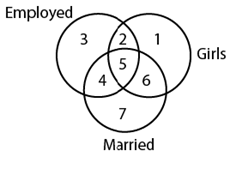
1735 160bdf16705aad558f1cd62a2
60bdf16705aad558f1cd62a2- 12true
- 24false
- 31false
- 45false
- Show AnswerHide Answer
- Workspace
- SingleChoice
Answer : 1. "2"
Q:Directions : Study the following alphanumeric series carefully and answer the questions given below:
12AIFR 42 WBOL 63EOCN 15TVMR 75GYTR
The letters which are attached with the numbers in which at least one is odd digit are arranged according to the ascending orders of their numbers from left to right and then all letters of the words together are arranged in the alphabetical order, then which of the following is the 9th letter from the right end?
1735 063dcf55dc386f46a0a576de5
63dcf55dc386f46a0a576de5- 1Mfalse
- 2Ofalse
- 3Ntrue
- 4Rfalse
- Show AnswerHide Answer
- Workspace
- SingleChoice
Answer : 3. "N"
Q: Select the option that is related to the third term in the same way as the second term is related to the first term.
Monk : Monastery :: Knight : ?
1734 0604f3049a01bc44789a12036
604f3049a01bc44789a12036- 1Stablefalse
- 2Cottagefalse
- 3Conventfalse
- 4Mansiontrue
- Show AnswerHide Answer
- Workspace
- SingleChoice
Answer : 4. "Mansion"
Q:Instructions: In each of the questions given below, one question and below it two statements I and II are given. You have to determine whether the data given in the statements is sufficient to answer the question or not.
Answer (A) if the data given in statement, I is sufficient to answer the question whereas data given only in statement II is not sufficient to answer the question.
Answer (B) if the data given only in statement II is sufficient to answer the question whereas data given
only in statement I is not sufficient to answer the question.
Answer (C) if the data given either only in statement I or only in statement II is sufficient to answer the question.
Answer (D) if the combined data given in statement I and statement II are not sufficient to answer the
question.
Answer (E) if the combined data given in statement I and statement II are necessary to answer the question.
How many sisters does K have?
I.M is sister of K.
II. Mother of K has three children.
1734 05fdc7bd4b025f97e019c24d1
5fdc7bd4b025f97e019c24d1Answer (A) if the data given in statement, I is sufficient to answer the question whereas data given only in statement II is not sufficient to answer the question.
Answer (B) if the data given only in statement II is sufficient to answer the question whereas data given
only in statement I is not sufficient to answer the question.
Answer (C) if the data given either only in statement I or only in statement II is sufficient to answer the question.
Answer (D) if the combined data given in statement I and statement II are not sufficient to answer the
question.
Answer (E) if the combined data given in statement I and statement II are necessary to answer the question.
I.M is sister of K.
II. Mother of K has three children.
- 1Afalse
- 2Bfalse
- 3Cfalse
- 4Dtrue
- 5Efalse
- Show AnswerHide Answer
- Workspace
- SingleChoice
Answer : 4. "D"
Q: X is more powerful than Y and Y is more powerful than Z. P is more powerful than Q but less than Y. Q is also more powerful than Z . Who is the least powerful?
1734 060b5fa3dadafcb4fbcf336f3
60b5fa3dadafcb4fbcf336f3- 1Xfalse
- 2Zfalse
- 3Qtrue
- 4Pfalse
- Show AnswerHide Answer
- Workspace
- SingleChoice
Answer : 3. "Q"
Q: Pointing to a woman. Raghav said. "Her son is my daughter's uncle". How is the woman related to Raghav?
1733 06081507a60a06a7ffda82166
6081507a60a06a7ffda82166- 1Sisterfalse
- 2Mothertrue
- 3Daughterfalse
- 4Grandmotherfalse
- Show AnswerHide Answer
- Workspace
- SingleChoice