


Reasoning Practice Question and Answer
8 Q:In the question given below , two statements are given followed by four Conclusion I, II, III and IV.You have to consider the two statements to be true even if they seem to be at variance from commonly known facts .You have to decide which of the given conclusion , if any , follow from the given statements.
Statements
All goats are tigers.
All tigers are lions.
Conclusions :
I. All tigers are goats
II. All lions are tigers
III. No goat is a lion
IV. No lion is a goat
1682 05ef2c29110419f1973eba915
5ef2c29110419f1973eba915All goats are tigers.
All tigers are lions.
Conclusions :
I. All tigers are goats
II. All lions are tigers
III. No goat is a lion
IV. No lion is a goat
- 1Either Il or III followsfalse
- 2Either Il or IV followsfalse
- 3Either I or III followsfalse
- 4None of the conclusions followtrue
- Show AnswerHide Answer
- Workspace
- SingleChoice
Answer : 4. "None of the conclusions follow"
Q: Three statements are given, followed by three conclusions numbered I, II and III. Assuming the statements to be true, even if they seem to be at variance with commonly known facts, decide which of the conclusions logically follow(s) from the statements.
Statements:
Some butters are honeys.
Some honeys are breads.
All breads are jams.
Conclusions:
I. Some jams are honeys.
II. All honeys are butters.
III. Some jams are butters.
1682 06447d2cbcd6ea382cf82e92f
6447d2cbcd6ea382cf82e92fSome butters are honeys.
Some honeys are breads.
All breads are jams.
I. Some jams are honeys.
II. All honeys are butters.
III. Some jams are butters.
- 1Only conclusions I and II followfalse
- 2Only conclusion II followsfalse
- 3Only conclusions I and III followfalse
- 4Only conclusion I followstrue
- Show AnswerHide Answer
- Workspace
- SingleChoice
Answer : 4. "Only conclusion I follows"
Q: Select the number that can replace the question mark (?) in the following series.
2807, 1400, 697, ?, 171, 84
1682 0611241fbb7b4a6411ff1fe25
611241fbb7b4a6411ff1fe252807, 1400, 697, ?, 171, 84
- 1371false
- 2346true
- 3697false
- 484false
- Show AnswerHide Answer
- Workspace
- SingleChoice
Answer : 2. "346"
Q:Direction: In these questions, relation between different elements is shown in the statements. The statements are followed by two conclusions. Study the conclusions based on the given statement and select the appropriate answer.
Statement: M ≤ K > L = Y; P ≤ T >M
Conclusions:
I. P> Y
II. T< L
1682 05e8da3bf2787283f7f87b280
5e8da3bf2787283f7f87b280Conclusions:
I. P> Y
II. T< L
- 1Only conclusion II is true.false
- 2Only conclusion I is true.false
- 3Either conclusion I or II are true.false
- 4Both conclusion I and II are truefalse
- 5None conclusion is truetrue
- Show AnswerHide Answer
- Workspace
- SingleChoice
Answer : 5. "None conclusion is true"
Q:Direction : Study the following information carefully and answer the given questions.
A, B, C, D, E, F, G and H are sitting around a circular area at equal distance between each other, but not necessarily in the same order. Some people face the centre while some face outward (i.e. in a direction opposite the centre.) B sits third to the right of E. E faces outward. Only one person sits between B and F. Both the immediate neighbours of F face outward. Only three persons sit between G and H. G is not an immediate neighbour of B. Both the immediate neighbours of D face the centre. D is not an immediate neighbour of G. Both the immediate neighbours of C face the centre. Both the immediate neighbours of E face a direction opposite that of G (i.e. if G faces the centre, then both the immediate neighbours of E face outward and vice versa).
Four of the following five are alike in a certain way based on the given arrangement and so form a group. Which is the one that does not belong to that group?
1681 05ea6636ec5fa916f4b61fb75
5ea6636ec5fa916f4b61fb75A, B, C, D, E, F, G and H are sitting around a circular area at equal distance between each other, but not necessarily in the same order. Some people face the centre while some face outward (i.e. in a direction opposite the centre.) B sits third to the right of E. E faces outward. Only one person sits between B and F. Both the immediate neighbours of F face outward. Only three persons sit between G and H. G is not an immediate neighbour of B. Both the immediate neighbours of D face the centre. D is not an immediate neighbour of G. Both the immediate neighbours of C face the centre. Both the immediate neighbours of E face a direction opposite that of G (i.e. if G faces the centre, then both the immediate neighbours of E face outward and vice versa).
- 1Bfalse
- 2Cfalse
- 3Htrue
- 4Dfalse
- 5Gfalse
- Show AnswerHide Answer
- Workspace
- SingleChoice
Answer : 3. "H"
Q: Select the combination of letters that when sequentially placed in the gaps of the given letters series will complete the series.
H _ _ EPCK _ _ CDEP _ KFHC _ EPC _ F
1681 06023abe7e4d6c265698e7bb1
6023abe7e4d6c265698e7bb1H _ _ EPCK _ _ CDEP _ KFHC _ EPC _ F
- 1CDFHCDKtrue
- 2CCFHKDKfalse
- 3DCFHFDDfalse
- 4CDHHDCKfalse
- Show AnswerHide Answer
- Workspace
- SingleChoice
Answer : 1. "CDFHCDK"
Q: Find the missing number?
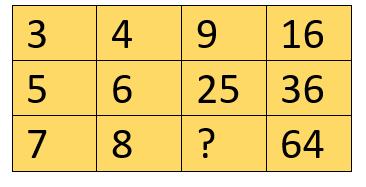
1680 05f607da72eed863f3a823712
5f607da72eed863f3a823712- 116false
- 249true
- 315false
- 418false
- Show AnswerHide Answer
- Workspace
- SingleChoice
Answer : 2. "49"
Q:Direction: In these questions the symbols $ , @ , £ , • and # are used with different meanings as given below :
' X $ Y ' means X is neither greater than nor smaller than Y '
' X @ Y ' means X is neither greater than nor equal to Y '
' X £ Y ' means X is neither smaller than nor equal to Y '
' X• Y ' means X is not smaller than Y '
' X # Y ' means X is not greater than Y '
( A ) If only conclusion I is true
( B ) If only conclusion II is true
( C ) If either conclusion I or II is true
(D ) If neither conclusion I nor II is true
( E ) If both conclusion I and II are true
Statements: V• D, D £ T, K $T, K # F
Conclusions:
I. D£K
II. T• F
1680 05e992732e5bd7218e0acd6b7
5e992732e5bd7218e0acd6b7' X $ Y ' means X is neither greater than nor smaller than Y '
' X @ Y ' means X is neither greater than nor equal to Y '
' X £ Y ' means X is neither smaller than nor equal to Y '
' X• Y ' means X is not smaller than Y '
' X # Y ' means X is not greater than Y '
( A ) If only conclusion I is true
( B ) If only conclusion II is true
( C ) If either conclusion I or II is true
(D ) If neither conclusion I nor II is true
( E ) If both conclusion I and II are true
Conclusions:
I. D£K
II. T• F
- 1Atrue
- 2Bfalse
- 3Cfalse
- 4Dfalse
- 5Efalse
- Show AnswerHide Answer
- Workspace
- SingleChoice