


Reasoning Practice Question and Answer
8 Q: Three statements are given followed by three conclusions numbered I, II and III. Assuming the statements to be true, even if they seem to be at variance with commonly known facts, decide which of the conclusions logically follow(s) from the statements.
Statements:
Some dogs are animals.
Some animals are pet.
All pets are white.
Conclusions:
I. Some dogs are white.
II. Some animals are white.
III. Some animals are dogs.
1162 0647864ee4e2d039e7bd2e856
647864ee4e2d039e7bd2e856Some dogs are animals.
Some animals are pet.
All pets are white.
I. Some dogs are white.
II. Some animals are white.
III. Some animals are dogs.
- 1All conclusions follow.false
- 2Only conclusions I and II follow.false
- 3Only conclusions II and III follow.true
- 4Only conclusions I and III follow.false
- Show AnswerHide Answer
- Workspace
- SingleChoice
Answer : 3. "Only conclusions II and III follow."
Q:Directions: Study the following information to answer the questions.
Twelve people are sitting in two parallel rows containing 6 people each, in such a way that there is an equal distance between adjacent persons. In row-1 P, Q, R, S, T, and U are seated and all of them are facing south. In row-2 A, B, C, D, E and F are seated and all facing North. Therefore, in the given seating arrangement each member seated in a row faces another member of the outer row.
S sits third to right of Q, either S or Q sits an extreme end of line. The one who faces Q sits second to right of E. Two people sits between B and F. Neither B nor F sits at an extreme end of the line. The immediate end of line.
The immediate neighbour of B faces the person who sits third to left of P, R and T are immediate neighbours of the each other. C sits second to the left of A. T does not face the immediate neighbour of D.
Who amongst the following faces S?
1161 05fdb3bcc8bd6a2764a5030ab
5fdb3bcc8bd6a2764a5030abS sits third to right of Q, either S or Q sits an extreme end of line. The one who faces Q sits second to right of E. Two people sits between B and F. Neither B nor F sits at an extreme end of the line. The immediate end of line.
The immediate neighbour of B faces the person who sits third to left of P, R and T are immediate neighbours of the each other. C sits second to the left of A. T does not face the immediate neighbour of D.
- 1Atrue
- 2Bfalse
- 3Cfalse
- 4Dfalse
- 5Ffalse
- Show AnswerHide Answer
- Workspace
- SingleChoice
Answer : 1. "A "
Q:Directions: Two statement are given followed by two conclusions I and II. You have to consider the two statements to be true even if they seem to be at variance from commonly known facts. You have to decide which one of the given conclusions are definitely drawn from the given statements:
Statements:
All University Professors have a doctorate degree.
X is a lady professor.
Conclusions:
I. X does not have a Doctorate degree.
II. Only men Professors have a Doctorate degree.
1161 06391b0f034f83f1472a5dfa7
6391b0f034f83f1472a5dfa7- 1Both I & II followfalse
- 2Only I followtrue
- 3Neither I nor II followsfalse
- 4Only II followsfalse
- Show AnswerHide Answer
- Workspace
- SingleChoice
Answer : 2. "Only I follow"
Q:Which of the following numbers will replace the question mark (?) in the given series?
67, 78, 71, 82, 75, 86, ?
1161 064cb77dcb6a5e472e27aa62e
64cb77dcb6a5e472e27aa62e- 197false
- 292false
- 384false
- 479true
- Show AnswerHide Answer
- Workspace
- SingleChoice
Answer : 4. "79"
Q:In the following question below are given some statements followed by some conclusions based on those statements. Taking the given statements to be true even if they seem to be at variance from commonly known facts. Read all the conclusions and then decide which of the given conclusion logically follows the given statements.
Statements:
I. All P are W.
II. No O is W.
Conclusion:
I. Some O are not P.
II. All W are O.
1161 064b683d888d5e4f52dd6d91a
64b683d888d5e4f52dd6d91aI. All P are W.
II. No O is W.
I. Some O are not P.
II. All W are O.
- 1Neither conclusion followsfalse
- 2Only conclusion I followstrue
- 3Only conclusion II followsfalse
- 4Both conclusions I and II followsfalse
- Show AnswerHide Answer
- Workspace
- SingleChoice
Answer : 2. "Only conclusion I follows"
Q: 2, 6, 12, 20, 30, 42, 56, ?
1160 05ff44c7ffc463f4c73681a68
5ff44c7ffc463f4c73681a68- 161false
- 264false
- 370false
- 472true
- Show AnswerHide Answer
- Workspace
- SingleChoice
Answer : 4. "72"
Explanation :
The pattern is 1 x 2, 2 x 3, 3 x 4, 4 x 5, 5 x 6, 6 x 7, 7 x 8.
So, the next number is 8 x 9 = 72.
Q: How many squares are there in the given firure.
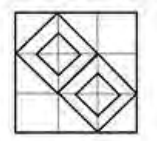
1160 0644aa6559471d8ce70d1c867
644aa6559471d8ce70d1c867- 124false
- 29false
- 312false
- 418true
- Show AnswerHide Answer
- Workspace
- SingleChoice
Answer : 4. "18"
Q: Select the number that can replace the question mark (?) in the following series.
31, 44, 58, 73, 89, ?
1160 0643e8123a16c2dfa9cf1fefa
643e8123a16c2dfa9cf1fefa- 1105false
- 2106true
- 3115false
- 4116false
- Show AnswerHide Answer
- Workspace
- SingleChoice