


Reasoning Practice Question and Answer
8 Q:In the following question below are given some statements followed by some conclusions based on those statements. Taking the given statements to be true even if they seem to be at variance from commonly known facts. Read all the conclusions and then decide which of the given conclusion logically follows the given statements.
Statements:
Some grasses are trees.
Some trees are branches.
Some branches are dogs.
Conclusions:
I. Some grasses are branches.
II. Some trees are dogs.
III. Some grasses are dogs.
IV. Some branches are grasses.
1070 064897dc1b90df94e034b6059
64897dc1b90df94e034b6059Some grasses are trees.
Some trees are branches.
Some branches are dogs.
I. Some grasses are branches.
II. Some trees are dogs.
III. Some grasses are dogs.
IV. Some branches are grasses.
- 1None of the conclusions followtrue
- 2Only conclusions II and III followfalse
- 3Only conclusions III and IV followfalse
- 4Only conclusions I and II followfalse
- Show AnswerHide Answer
- Workspace
- SingleChoice
Answer : 1. "None of the conclusions follow"
Q: Select the correct combination of mathematical signs to sequentially replace the * signs and to balance the given equation.
25 * 4 * 6 * 2 * 17
1067 06489a0d9bf323e479ab13fe4
6489a0d9bf323e479ab13fe425 * 4 * 6 * 2 * 17
- 1−, +, ×, =false
- 2+, −, =, +false
- 3+, −, ÷, =false
- 4+, −, ×, =true
- Show AnswerHide Answer
- Workspace
- SingleChoice
Answer : 4. "+, −, ×, ="
Q: Select the set in which the numbers are related in the same way as are the numbers of the following set.
(56, 8, 15)
(32, 16, 18)
(NOTE : Operations should be performed on the whole numbers, without breaking down the numbers into its constituent digits. E.g. 13 – Operations on 13 such as adding /deleting /multiplying etc. to 13 can be performed. Breaking down 13 into 1 and 3 and then performing mathematical operations on 1 and 3 is NOT allowed)
1066 0646353484d91510a5db8a7ad
646353484d91510a5db8a7ad(56, 8, 15)
(32, 16, 18)
(NOTE : Operations should be performed on the whole numbers, without breaking down the numbers into its constituent digits. E.g. 13 – Operations on 13 such as adding /deleting /multiplying etc. to 13 can be performed. Breaking down 13 into 1 and 3 and then performing mathematical operations on 1 and 3 is NOT allowed)
- 1(75, 5, 15)false
- 2(70, 5, 13)false
- 3(66, 6, 17)true
- 4(68, 4, 17)false
- Show AnswerHide Answer
- Workspace
- SingleChoice
Answer : 3. "(66, 6, 17)"
Q: Select the correct combination of mathematical signs to sequentially replace the * signs and to balance the given equation.
20 * 2 * 50 * 5 * 115
1066 0649c207aab3c5fffc2e5f4d6
649c207aab3c5fffc2e5f4d620 * 2 * 50 * 5 * 115
- 1−, ×, =, +false
- 2+, ×, =, −false
- 3+, ×, −, =true
- 4−, ×, +, =false
- Show AnswerHide Answer
- Workspace
- SingleChoice
Answer : 3. "+, ×, −, ="
Q: Select the correct mirror image of the given combination when the mirror is placed at MNas shown.

1065 0644fa11913eb5908ae2af0bf
644fa11913eb5908ae2af0bf - 1true

- 2false

- 3false

- 4false

- Show AnswerHide Answer
- Workspace
- SingleChoice
Answer : 1. "
"
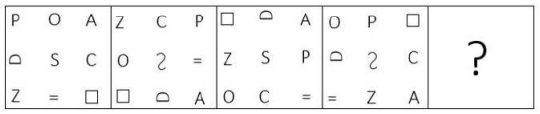
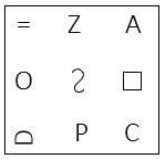
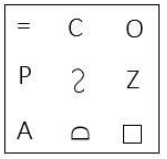
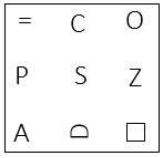
Q:Select the figure from among the given options that can replace the question mark (?) in the following series.
Question figure.
1063 06479bc3ef4063d472f1a80b1
6479bc3ef4063d472f1a80b1- 1true

- 2false
- 3false
- 4false
- Show AnswerHide Answer
- Workspace
- SingleChoice
Answer : 1. "
"
Q:Directions: In these questions, a relationship between different elements is shown in the statements. The statements are followed by two conclusions. Give answer
Statement
L ≤ T ≤ I ≥ M < X,
W < P ≤ L ≥ B ≥ K
Conclusion
I. K ≥ M
II. P > M
1062 064df552674cca449497cf1ce
64df552674cca449497cf1ceL ≤ T ≤ I ≥ M < X,
W < P ≤ L ≥ B ≥ K
I. K ≥ M
II. P > M
- 1if only conclusion II is true.false
- 2if either conclusion I or II is true.false
- 3if neither conclusion I nor II is true.true
- 4if only conclusion I is true.false
- 5if both conclusions I and II are true.false
- Show AnswerHide Answer
- Workspace
- SingleChoice
Answer : 3. "if neither conclusion I nor II is true."
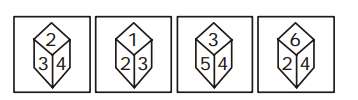
Q: Study th e following figures and find out the number opposite to 2.
1058 0644813334f5953686feb3586
644813334f5953686feb3586- 14false
- 25true
- 36false
- 43false
- Show AnswerHide Answer
- Workspace
- SingleChoice