


Reasoning Practice Question and Answer
8 Q:Direction: In the following questions assuming the given a statement to be true, find which of the conclusion(s) among given conclusions is/are true and then give your answers accordingly.
Statements:
T> Y > U > I ≥ K; V < B < N< M; K
≤ J ≤ H = G ≥ V
Conclusion:
I. I > H
II. G < N
1002 064d360c9e0ce557496875cc3
64d360c9e0ce557496875cc3T> Y > U > I ≥ K; V < B < N< M; K
≤ J ≤ H = G ≥ V
I. I > H
II. G < N
- 1Only I followsfalse
- 2Only II followsfalse
- 3Either I or II followsfalse
- 4Both I and II followfalse
- 5Neither I nor II followstrue
- Show AnswerHide Answer
- Workspace
- SingleChoice
Answer : 5. "Neither I nor II follows"
Q:Select the odd word/letters/number/number pair from the given alternatives.
Option
1000 0640b394586fd41614681b4d6
640b394586fd41614681b4d6- 18true
- 242false
- 349false
- 435false
- Show AnswerHide Answer
- Workspace
- SingleChoice
Answer : 1. "8"
Q:Select the number from among the given options that can replace the question mark (?) in the following series.
Question figure.
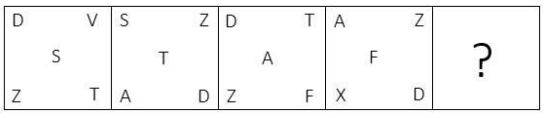
998 06489855cb50f5316a45d36eb
6489855cb50f5316a45d36eb- 1false
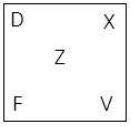
- 2false
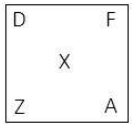
- 3true
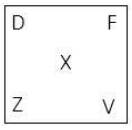
- 4false
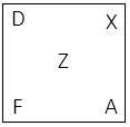
- Show AnswerHide Answer
- Workspace
- SingleChoice
Answer : 3. "
"
Q:Directions: Read the given information carefully and answer the following questions:
7 Persons Ram, Mani, Rupa, Mano, Sahil, Saroja, and Ravi are sitting in a linear row facing north. They all like different flowers i.e., Rose, Lily, Jasmine, Marigold, Lotus, Daisy, and Orchid but not necessarily in the same order.
Ravi, who doesn't sit at the extreme ends, sits third to the right of Mani. The number of persons sitting to the right of the one, who likes Orchid is same as the number of persons sitting to the left of Rupa. The one, who likes Lily sits immediate right of Rupa, who sits to the left of Mani. Sahil sits third to the left of Ram, who likes Marigold. Mano sits to the right of Ram. The number of persons sitting to the left of the one, who likes Jasmine is two more than the number of persons sitting to the right of Mano. The one, who likes Rose sits to the left of the one, who likes Daisy. Saroja likes Lotus but does not sit adjacent to Ravi.
Who among the following sits at the extreme end?
997 064df42692e3b664a0a4a93a6
64df42692e3b664a0a4a93a6- 1Sarojafalse
- 2Rupatrue
- 3Ramfalse
- 4Sahilfalse
- 5None of thesefalse
- Show AnswerHide Answer
- Workspace
- SingleChoice
Answer : 2. "Rupa"
Q: In a certain code language, 'GREAT' is codedas '2015187', 'WORK' is codedas '11181523' and 'GOING' is codedas '7149157'. How will ‘WELL' be codedin that language?
993 06458d95439143d085f4cc388
6458d95439143d085f4cc388- 11425431false
- 23231345false
- 31454321false
- 41212523true
- Show AnswerHide Answer
- Workspace
- SingleChoice
Answer : 4. "1212523"
Q:Directions: In the following question assuming the given statements to be true, find which of the conclusions among the given conclusions is/ are definitely true and then give your answers accordingly
Statements:
T < P ≤ U; L > U ≤ R = O ≥ Y = S
Conclusions:
I. R ≥ S II. T < R
993 064e870882e7e7af712beea0e
64e870882e7e7af712beea0eT < P ≤ U; L > U ≤ R = O ≥ Y = S
I. R ≥ S II. T < R
- 1Only I is truefalse
- 2Only II is truefalse
- 3Either I or II is truefalse
- 4Both I and II is truetrue
- 5Neither I nor II is truefalse
- Show AnswerHide Answer
- Workspace
- SingleChoice
Answer : 4. "Both I and II is true"
Q: By interchanging the given two signs and numbers which of the following equation will be correct?
× and +, 9 and 6
992 064897fb9b50f5316a45d248f
64897fb9b50f5316a45d248f× and +, 9 and 6
- 17 × 6 ÷ 3 + 9 – 8 = 17true
- 26 × 8 – 9 ÷ 3 + 5 = 50false
- 37 + 6 × 4 ÷ 9 – 8 = 8false
- 49 × 7 + 4 ÷ 1 – 6 = 7false
- Show AnswerHide Answer
- Workspace
- SingleChoice
Answer : 1. "7 × 6 ÷ 3 + 9 – 8 = 17"
Q: Read the given statements and conclusions carefully. Assuming that the information given in the statements is true, even if it appears to be at variance with commonly known facts, decide which of the given conclusions logically follow(s) from the statements.
Statements:
I. All T are Q.
II. No M is T.
Conclusions:
I. No T is M.
II. Some Q are not M.
990 064211243b34a0b67fc06da37
64211243b34a0b67fc06da37- 1Only conclusion I followsfalse
- 2Neither conclusion I nor II followsfalse
- 3Only conclusion II followsfalse
- 4Both conclusions I and II followtrue
- Show AnswerHide Answer
- Workspace
- SingleChoice