


Practice Question and Answer
8Q: Where and when the first session of Indian National Congress was held ? 2163 05b5cc6c0e4d2b4197774daee
5b5cc6c0e4d2b4197774daee- 1Delhi, 1890false
- 2Mumbai, 1885true
- 3Madras, 1887false
- 4Kolkata, 1889false
- Show AnswerHide Answer
- Workspace
- SingleChoice
Answer : 2. "Mumbai, 1885"
Explanation :
Answer: B) Mumbai, 1885 Explanation: The first session of Indian National Congress was held from 28–31 December 1885, in Mumbai and was attended by 72 delegates. Womesh Chandra Bonnerjee was the first president of the Indian National Congress (INC), a voice of Indian opinion to the British government.
Q:A word is represented by only one set of numbers as given in anyone of the alternatives. The sets of numbers given in the alternatives are represented by two classes of alphabets as in two matrices given below. The columns and rows of matrix I are numbered from 0 to 4 and that of matrix II are numbered from 5 to 9. A letter from these matrices can be represented first by its row and next by its column, e. g., ' B ' can be represented by 04, 11, 23, etc. and ' N ' can be represented by 59, 66, 78, etc. Identify the set for the word MILK.
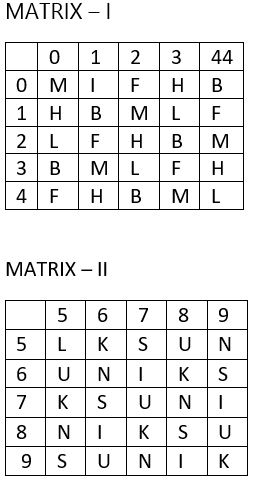
2163 15d98578568fda74fcf5748e2
5d98578568fda74fcf5748e2- 112, 67, 32, 99true
- 231, 86, 33, 87false
- 321, 76, 32, 95false
- 410, 67, 42, 88false
- Show AnswerHide Answer
- Workspace
- SingleChoice
Answer : 1. "12, 67, 32, 99"
Q: In a code language, PASTEUR is coded as TPRUASE. How would SEVENTY be coded in that language?
2163 460bdfdeb943add67dd72e444
60bdfdeb943add67dd72e444- 1ESYETNVfalse
- 2ESYTEVNtrue
- 3ENVETYSfalse
- 4NSYTEVNfalse
- Show AnswerHide Answer
- Workspace
- SingleChoice
Answer : 2. "ESYTEVN"
Q: Who was given the status of "National Monarch" by historians?
2163 060f6ac8016158a5eeda5455b
60f6ac8016158a5eeda5455b- 1Baburfalse
- 2Akbartrue
- 3Shah Jahanfalse
- 4Humayunfalse
- Show AnswerHide Answer
- Workspace
- SingleChoice
Answer : 2. "Akbar"
Q: Madhu got 32% of the maximum marks in a Bank examination and failed by 8 marks. However, Kumar who took the same examination got 42% of the total marks and got 16 marks more than the cut-off marks. What was the cut-off marks in the examination ? 2163 05b5cc6d1e4d2b4197774e3d4
5b5cc6d1e4d2b4197774e3d4- 176.8false
- 286.8false
- 378.8false
- 484.8true
- Show AnswerHide Answer
- Workspace
- SingleChoice
Answer : 4. "84.8"
Explanation :
Answer: D) 84.8 Explanation: Let 'M' be the maximum marks in the examination. Therefore, Madhu got 32% of M = 32M/100 = 0.32MAnd Kumar got 42% of M = 42M/100 = 0.42M.In terms of the maximum marks Kumar got 0.42M - 0.32M = 0.1M more than Madhu. ---- (1) The problem however, states that Kumar got 16 marks more than the cut-off mark and Madhu got 8 marks less than the cut-off mark. Therefore, Kumar has got 16 + 8 = 24 marks more than Madhu. ---- (2) Now, Equating (1) and (2), we get0.1M = 24 => M = 24/0.1 = 240'M' is the maximum mark and is equal to 240 marks.We know that Madhu got 32% of the maximum marks.Therefore, Madhu got 32 x 240/100 = 76.8 marks.We also know that Madhu got 8 marks less than the cut-off marks. Therefore, the cut-off marks will be 8 marks more than what Madhu got = 76.8 + 8 = 84.8.
Q: What is the use of Paste With Live Preview in MS Excel 2010?
2163 061cdc9608067f406dfea06fa
61cdc9608067f406dfea06fa- 1It avoids repeated hits and trails and you can easily re-use the content preview.true
- 2It can repair all files and folders.false
- 3It is useful for computing unknown values.false
- 4No such preview is available in MS Excel 2010.false
- Show AnswerHide Answer
- Workspace
- SingleChoice
Answer : 1. "It avoids repeated hits and trails and you can easily re-use the content preview."
Q: Do plant cells have Mitochondria? 2163 05b5cc6a3e4d2b4197774cbf7
5b5cc6a3e4d2b4197774cbf7- 1Yestrue
- 2Nofalse
- 3Can't be determinedfalse
- 4Nonefalse
- Show AnswerHide Answer
- Workspace
- SingleChoice
Answer : 1. "Yes"
Explanation :
Answer: A) Yes Explanation: Yes, plant cells have Mitochondria. While plant cells have chloroplasts to photosynthesize, they also require ATP for cellular functions, and do use oxygen to break down some of the sugar they produce in order to generate that ATP. They need mitochondria for this. In particular, at night when there is no light, plants undergo cellular respiration since there is no sunlight to photosynthesize. They do, however, produce far more sugar and oxygen through photosynthesis than they use up in respiration.
Q: Is DRAM Volatile or Nonvolatile? 2163 05b5cc6a6e4d2b4197774cda6
5b5cc6a6e4d2b4197774cda6- Show AnswerHide Answer
- Workspace
- SingleChoice
Answer :
Explanation :
DRAM is a Volatile random-access memory (VRAM). Volatile random-access memory (VRAM) is random-access memory that retains its information when power is turned on. Examples of volatile memory are primary storage (typically dynamic RAM, DRAM), and fast CPU cache memory (typically static RAM, SRAM, which is fast but energy-consuming and offer lower memory capacity per area unit than DRAM). Non-volatile random-access memory (NVRAM) is random-access memory that retains its information when power is turned off. Examples of non-volatile memory are flash memory (used as secondary memory) and ROM, PROM, EPROM and EEPROM memory (used for storing firmware such as BIOS).