


Practice Question and Answer
8Q: What Room can Nobody Enter? 2113 05b5cc6abe4d2b4197774cfea
5b5cc6abe4d2b4197774cfea- 1War roomfalse
- 2Spare roomfalse
- 3Escape roomfalse
- 4Mushroomtrue
- Show AnswerHide Answer
- Workspace
- SingleChoice
Answer : 4. "Mushroom"
Explanation :
Answer: D) Mushroom Explanation: The Room can Nobody Enter is a Mushroom.
Q: Mica is available abundantly in 2113 05b5cc6b6e4d2b4197774d57d
5b5cc6b6e4d2b4197774d57d- 1Andhra Pradesh, Jharkand, Bihartrue
- 2Bihar, Gujarat, Telanganafalse
- 3Andhra Pradesh, Karnataka, Jharkandfalse
- 4Telangana, Andhra Pradesh, Biharfalse
- Show AnswerHide Answer
- Workspace
- SingleChoice
Answer : 1. "Andhra Pradesh, Jharkand, Bihar"
Explanation :
Answer: A) Andhra Pradesh, Jharkand, Bihar Explanation: According to 2005 - 2006 census - Jharkand According to 2011 - 2012 census - Andhra Pradesh are the highest producers of Mica in India.
Q: Translator program used in assembly language 2113 05b5cc64de4d2b4197774bc75
5b5cc64de4d2b4197774bc75- 1Assemblertrue
- 2Interpreterfalse
- 3Compilerfalse
- 4Operating systemfalse
- Show AnswerHide Answer
- Workspace
- SingleChoice
Answer : 1. "Assembler"
Explanation :
Answer: A) Assembler Explanation: Assemblers are used to translate a program written in a low-level assembly language into a machine code (object code) file so it can be used and executed by the computer. Hence, Assembler is the translator program used in assembly language.
Q: The situation with increasing unemployment and inflation is termed as:
2113 05e99ad7b1dda1f42d77fc833
5e99ad7b1dda1f42d77fc833- 1Deflationfalse
- 2Galloping inflationfalse
- 3Hyper inflationfalse
- 4Stagflationtrue
- 5None of thesefalse
- Show AnswerHide Answer
- Workspace
- SingleChoice
Answer : 4. "Stagflation"
Q: In each of the following questions, four numbers are given out of which three are like in some manner while one is different. Choose the one which is different from the rest three?
2112 05fc787d5d0af4c56f5e86170
5fc787d5d0af4c56f5e86170- 1360false
- 2480false
- 3140true
- 4240false
- Show AnswerHide Answer
- Workspace
- SingleChoice
Answer : 3. "140"
Q: Where was the first cement factory established in Rajasthan?
2112 06411b26386fd41614690a393
6411b26386fd41614690a393- 1Lakheritrue
- 2Dabokfalse
- 3Beawarfalse
- 4Gotanfalse
- Show AnswerHide Answer
- Workspace
- SingleChoice
Answer : 1. "Lakheri"
Explanation :
The first cement factory in Rajasthan was established in Lakheri (Bundi). This factory was established in 1915 by the Associated Cement Company Limited (ACC). It is the longest-running cement factory in Asia. In 2022, ACC became part of the Adani Group.
Q: Study the following graph and answer the question that follow.
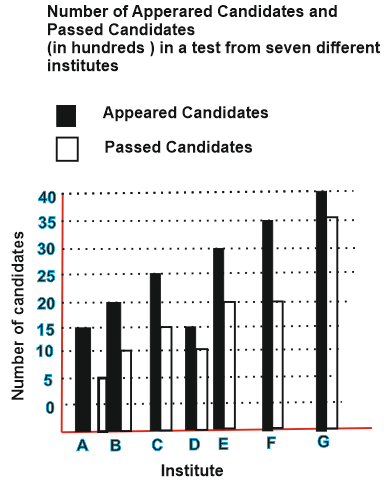 From which institute is the difference between the appeared candidates and passed candidates maximum?
2112 05d860d9bd0d7a00e4ecbb1b4
5d860d9bd0d7a00e4ecbb1b4From which institute is the difference between the appeared candidates and passed candidates maximum?- 1Bfalse
- 2Gfalse
- 3Dfalse
- 4Ftrue
- 5None of thesefalse
- Show AnswerHide Answer
- Workspace
- SingleChoice
Answer : 4. "F"
Q: Rearrange the following sentences ( 2112 05b5cc6c8e4d2b4197774df4b
5b5cc6c8e4d2b4197774df4b- 1, (false
- 2, (true
- 3, (false
- 4, (E) and (F) in the proper sequence to form a meaningful paragraph. (false
- Show AnswerHide Answer
- Workspace
- SingleChoice
Answer : 2. ", ("
Explanation :
Answer: B) E C F A D B Explanation: