


Practice Question and Answer
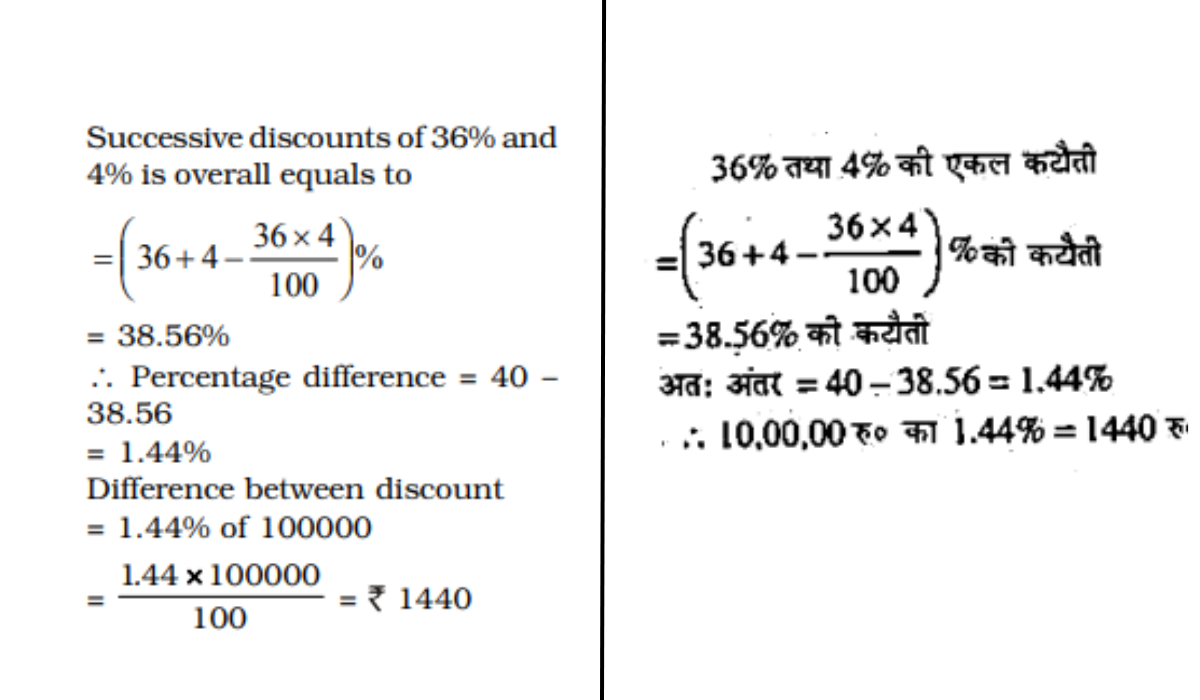
8 Q: Applied to a bill for ₹ 1,00,000 the difference between a discount of 40% and two successive discounts of 36% and 4% is:
1079 0624d4deebadeb679cf085570
624d4deebadeb679cf085570- 1₹ 2,500false
- 2₹ 4,000false
- 3₹ 1,500false
- 4₹ 1,440true
- Show AnswerHide Answer
- Workspace
- SingleChoice
Answer : 4. "₹ 1,440 "
Explanation :
Q: Who was the contemporary of Queen Elizabeth I of Britain?
9120 05ed5c9115ccf7008ed8c131a
5ed5c9115ccf7008ed8c131a- 1Akbartrue
- 2Jahangirfalse
- 3Shah Jahanfalse
- 4Aurangzebfalse
- Show AnswerHide Answer
- Workspace
- SingleChoice
Answer : 1. "Akbar"
Explanation :
Elizabeth I (r. 1558–1603) was the last Tudor monarch and a contemporary of the Mughal emperor Akbar (r. 1556–1605).
Q: 'Panchayati Raj' started?
1060 0608a596936f5727dff28f2c5
608a596936f5727dff28f2c5- 11952false
- 21947false
- 31979false
- 41959true
- Show AnswerHide Answer
- Workspace
- SingleChoice
Answer : 4. "1959"
Explanation :
Panchayati Raj system was implemented by the then Prime Minister Jawaharlal Nehru in Bagdhari village of Nagaur district of Rajasthan on 2 October 1959.
Q: The Setting a Supreme Court was Calcutta is a part of ?
3499 05d947f2f15db5f22bbeb4916
5d947f2f15db5f22bbeb4916- 1Regulating Act of 1773true
- 2Pitts India Act of 1784false
- 3Charter Act of 1793false
- 4Charter Act of 1893false
- Show AnswerHide Answer
- Workspace
- SingleChoice
Answer : 1. "Regulating Act of 1773"
Explanation :
The correct answer is Regulating act of 1773. The Supreme Court at Calcutta was established by Regulating act of 1773.
Q: Which of the following is not a Panchayati Raj Institution?
1388 06243e1bc0c8d6f4df13d2f7b
6243e1bc0c8d6f4df13d2f7b- 1Gram Sabhafalse
- 2Gram Panchayatfalse
- 3Village Co-operative Societytrue
- 4Panchayat Samitifalse
- Show AnswerHide Answer
- Workspace
- SingleChoice
Answer : 3. "Village Co-operative Society"
Explanation :
1. The Ministry of Panchayati Raj is a branch of the Government of India that looks after the ongoing process of decentralization and local governance in the states.
2. The Panchayati Raj system is the system of local self-government in rural India. Just as self-governance of urban areas is carried out through municipalities and suburban municipalities, similarly self-governance of rural areas is carried out through Panchayati Raj institutions.
3. There are three levels of Panchayati Raj institutions.
(1) Village level: Gram Panchayat
(2) Block level: Panchayat Samiti
(3) District level: District Council
Q: In India, which day is celebrated as the National Panchayati Raj Day?
1540 06087c13a0ac1df7d9f7cf67b
6087c13a0ac1df7d9f7cf67b- 123 Aprilfalse
- 221 Aprilfalse
- 322 Aprilfalse
- 424 Apriltrue
- Show AnswerHide Answer
- Workspace
- SingleChoice
Answer : 4. "24 April"
Explanation :
1. The provisions related to Panchayati Raj have been discussed in the original Constitution under Part 9 by the 73rd Constitutional Amendment Act, 1992 (Article 243). Part 9, under the heading ‘Panchayats’, contains provisions related to Panchayati Raj up to Articles 243-243O (243-243O).
2. Panchayati Raj Day is celebrated every year on 24 April in India as the foundation of democracy.
3. The Panchayati Raj system is the system of local self-government in rural India.
4. Panchayati Raj system was implemented by the then Prime Minister Jawaharlal Nehru in Bagdhari village of Nagaur district of Rajasthan on 2 October 1959.
5. Local government form was first adopted in the states of Rajasthan and Andhra Pradesh.
6. The concept of Panchayati Raj in the Indian Constitution is enshrined in the Directive Principles of State Policy.
7. The tenure of Panchayats is fixed for five years but it can be dissolved even before the tenure.
Q: Which of the following committee is known to recommend 3-tier Panchayati Raj system?
1340 06101146a0b25de5a90f40467
6101146a0b25de5a90f40467- 1Ashok Mehta Committeefalse
- 2Balwant Rai Mehta Committeetrue
- 3Sarkaria Committeefalse
- 4Rao Committeefalse
- Show AnswerHide Answer
- Workspace
- SingleChoice
Answer : 2. "Balwant Rai Mehta Committee"
Explanation :
1. The provisions related to Panchayati Raj have been discussed in the original Constitution under Part 9 by the 73rd Constitutional Amendment Act, 1992 (Article 243). Part 9, under the heading ‘Panchayats’, contains provisions related to Panchayati Raj up to Articles 243-243O (243-243O).
2. Panchayati Raj Day is celebrated every year on 24 April in India as the foundation of democracy.
3. The Panchayati Raj system is the system of local self-government in rural India.
4. Panchayati Raj system was implemented by the then Prime Minister Jawaharlal Nehru in Bagdhari village of Nagaur district of Rajasthan on 2 October 1959.
5. Local government form was first adopted in the states of Rajasthan and Andhra Pradesh.
6. The concept of Panchayati Raj in the Indian Constitution is enshrined in the Directive Principles of State Policy.
7. The tenure of Panchayats is fixed for five years but it can be dissolved even before the tenure.
8. All types of major committees related to Panchayati Raj are as follows
- Balwant Rai Mehta Committee (1957)
- Ashok Mehta Committee (1977)
- Yes. V.K Rao Committee (1985)
- L.M. Singhvi Committee (1986)
Q: The National Panchayati Raj Day is observed on which date in India?
1288 05ea94f1b07542b13ae2c6239
5ea94f1b07542b13ae2c6239- 123 Aprilfalse
- 222 Aprilfalse
- 324 Apriltrue
- 421 Aprilfalse
- Show AnswerHide Answer
- Workspace
- SingleChoice
Answer : 3. "24 April"
Explanation :
1. The provisions related to Panchayati Raj have been discussed in the original Constitution under Part 9 by the 73rd Constitutional Amendment Act, 1992 (Article 243). Part 9, under the heading ‘Panchayats’, contains provisions related to Panchayati Raj up to Articles 243-243O (243-243O).
2. Panchayati Raj Day is celebrated every year on 24 April in India as the foundation of democracy.