


Practice Question and Answer
8 Q:Study the following information carefully and answer the questions given below:
Twelve people are sitting in two parallel rows containing six people in such a way that there is an equal distance between adjacent persons. In Row I- A, B, Z, D, E and M are seated and all of them are facing north. In row II- P, K, R, S, T and G are seated and all of them are facing south. Therefore, in the given seating arrangement each member seated in a row faces opposite of another member of the other row. G sits third to the right of S. G sits opposite to M. D sits third to the right of Z. R sits opposite to Z. The one who is facing E sits third to the right of P. B and E do not sit at the extreme ends of the line. T is not an immediate neighbour of G and A is not an immediate neighbour of B. K does not face D.
Four of the following five are alike in a certain way and so from a group, which one does not belongs to that group?
1333 060a4f793f98a5977251a2f83
60a4f793f98a5977251a2f83- 1Dtrue
- 2Pfalse
- 3Gfalse
- 4Afalse
- 5Mfalse
- Show AnswerHide Answer
- Workspace
- SingleChoice
Answer : 1. " D "
Q:Study the following information carefully and answer the questions given below:
Twelve people are sitting in two parallel rows containing six people in such a way that there is an equal distance between adjacent persons. In Row I- A, B, Z, D, E and M are seated and all of them are facing north. In row II- P, K, R, S, T and G are seated and all of them are facing south. Therefore, in the given seating arrangement each member seated in a row faces opposite of another member of the other row. G sits third to the right of S. G sits opposite to M. D sits third to the right of Z. R sits opposite to Z. The one who is facing E sits third to the right of P. B and E do not sit at the extreme ends of the line. T is not an immediate neighbour of G and A is not an immediate neighbour of B. K does not face D.
Which amongst the following is true regarding B?
1447 060a4f6d863194a66f2d081ec
60a4f6d863194a66f2d081ec- 1B is immediate neighbour of Z.false
- 2B is at the end of the row.false
- 3B is in front of R.false
- 4B and D are immediate neighbour of each other.true
- 5B is opposite of T.false
- Show AnswerHide Answer
- Workspace
- SingleChoice
Answer : 4. "B and D are immediate neighbour of each other. "
Q:Study the following information carefully and answer the questions given below:
Twelve people are sitting in two parallel rows containing six people in such a way that there is an equal distance between adjacent persons. In Row I- A, B, Z, D, E and M are seated and all of them are facing north. In row II- P, K, R, S, T and G are seated and all of them are facing south. Therefore, in the given seating arrangement each member seated in a row faces opposite of another member of the other row. G sits third to the right of S. G sits opposite to M. D sits third to the right of Z. R sits opposite to Z. The one who is facing E sits third to the right of P. B and E do not sit at the extreme ends of the line. T is not an immediate neighbour of G and A is not an immediate neighbour of B. K does not face D.
Who amongst the following represents the people seating at the extreme ends of the rows?
1467 060a4f658f98a5977251a2da3
60a4f658f98a5977251a2da3- 1P, Zfalse
- 2A, Zfalse
- 3A, Mtrue
- 4G, Dfalse
- 5T, Sfalse
- Show AnswerHide Answer
- Workspace
- SingleChoice
Answer : 3. "A, M "
Q:Study the following information carefully and answer the questions given below:
Twelve people are sitting in two parallel rows containing six people in such a way that there is an equal distance between adjacent persons. In Row I- A, B, Z, D, E and M are seated and all of them are facing north. In row II- P, K, R, S, T and G are seated and all of them are facing south. Therefore, in the given seating arrangement each member seated in a row faces opposite of another member of the other row. G sits third to the right of S. G sits opposite to M. D sits third to the right of Z. R sits opposite to Z. The one who is facing E sits third to the right of P. B and E do not sit at the extreme ends of the line. T is not an immediate neighbour of G and A is not an immediate neighbour of B. K does not face D.
How many persons are seated between G and S?
1488 060a4f5a8f98a5977251a2d40
60a4f5a8f98a5977251a2d40- 1Threefalse
- 2Fourfalse
- 3Onefalse
- 4Twotrue
- 5More than fourfalse
- Show AnswerHide Answer
- Workspace
- SingleChoice
Answer : 4. "Two "
Q:Study the following information carefully and answer the questions given below:
Twelve people are sitting in two parallel rows containing six people in such a way that there is an equal distance between adjacent persons. In Row I- A, B, Z, D, E and M are seated and all of them are facing north. In row II- P, K, R, S, T and G are seated and all of them are facing south. Therefore, in the given seating arrangement each member seated in a row faces opposite of another member of the other row. G sits third to the right of S. G sits opposite to M. D sits third to the right of Z. R sits opposite to Z. The one who is facing E sits third to the right of P. B and E do not sit at the extreme ends of the line. T is not an immediate neighbour of G and A is not an immediate neighbour of B. K does not face D.
Who amongst the following sits opposite to S?
1515 060a4f540b1d2440614c04259
60a4f540b1d2440614c04259- 1Afalse
- 2Btrue
- 3Dfalse
- 4Gfalse
- 5Kfalse
- Show AnswerHide Answer
- Workspace
- SingleChoice
Answer : 2. "B "
Q:Direction : The table given below represents number of bikes of five different brands sold from 2001- 2005, with the help of data given in the table, answer the following questions.
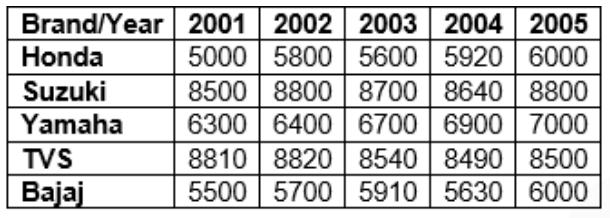
If sales of Suzuki in the year 2006 is increased by 5% and sales of Yamaha decreased by 5%, then what is the difference of averages of sales of Suzuki in year 2001 and 2006 and average sales of Yamaha in 2002 and 2006?
1430 060a4f033f98a5977251a2404
60a4f033f98a5977251a2404- 11170false
- 22000false
- 32330false
- 42345true
- 5None of thesefalse
- Show AnswerHide Answer
- Workspace
- SingleChoice
Answer : 4. "2345"
Q:Direction : The table given below represents number of bikes of five different brands sold from 2001- 2005, with the help of data given in the table, answer the following questions.
What is the ratio of average sales of TVS in year 2002 and 2005 to the average sales of Honda in year 2001 and 2004?
1363 060a4ef9163194a66f2d07028
60a4ef9163194a66f2d07028- 1273:433false
- 2433: 273true
- 3111:142false
- 4441:173false
- 5None of thesefalse
- Show AnswerHide Answer
- Workspace
- SingleChoice
Answer : 2. "433: 273"
Q:Direction : The table given below represents number of bikes of five different brands sold from 2001- 2005, with the help of data given in the table, answer the following questions.
The average sale of Bajaj from 2001 to 2005 is what percentage of total sales of Suzuki from 2001-2005?
1589 060a4ef29b33a50608a41f7ff
60a4ef29b33a50608a41f7ff- 114%false
- 213.23%true
- 312.22%false
- 415.23%false
- 5None of thesefalse
- Show AnswerHide Answer
- Workspace
- SingleChoice