


Practice Question and Answer
8 Q: Under whose Chairmanship a huge convention of Meena Caste was held in April 1944 at Neemkathana?
3290 06307bae31ff92f3f9e6fe372
6307bae31ff92f3f9e6fe372- 1Shantisagar Ji Maharajfalse
- 2Magansagar Ji Maharajtrue
- 3Hiralal Shastrifalse
- 4Shobhalal Guptafalse
- Show AnswerHide Answer
- Workspace
- SingleChoice
Answer : 2. "Magansagar Ji Maharaj"
Q: In the following questions, a part of the sentence is printed in bold. Below are given alternatives to the bold part at (a), (b) and (c) which may improve the sentence. Choose the correct alternatives. In case no improvement is needed, your answer is (d).
Geometry and Drawing is more easier than Geography and Social Studies.
3289 05ebebee6b54ef762314bb715
5ebebee6b54ef762314bb715- 1are easier thantrue
- 2are easier rather thanfalse
- 3is easy thanfalse
- 4No improvementfalse
- Show AnswerHide Answer
- Workspace
- SingleChoice
Answer : 1. "are easier than"
Q:A sentence has been given in Direct/Indirect Speech. Out of the four given alternatives, select the one which best expresses the same sentence in Indirect/Direct Speech.
I know her well said Manisha.
3289 05e7afc694572817353d91e51
5e7afc694572817353d91e51- 1Manisha said that she knew her well.true
- 2Manisha said if she knows her well.false
- 3Manisha said that she knows her.false
- 4Manisha says that she knew her well.false
- Show AnswerHide Answer
- Workspace
- SingleChoice
Answer : 1. "Manisha said that she knew her well."
Q:Directions (Q .121 - 125 ): Read each sentence to find out whether there is any . grammatical error or idiomatic error in it. The error, if any, will be in one part of the sentence. The number of that part is the answer. If there is ' No error the answer is (5). (Ignore errors of punctuation if any).
Ajay was adamant ( 1 ) / on finishing work before leaving ( 3 ) / by the day . ( 4 ) / No error ( 5 )
3289 05da41963d69109270473a981
5da41963d69109270473a981- 11false
- 22false
- 33false
- 44false
- 55true
- Show AnswerHide Answer
- Workspace
- SingleChoice
Answer : 5. "5"
Q: A, B, C, D, E, F, G and H are sitting around a circular table facing the centre but not necessarily in the same order.
C is an immediate neighbour of both G and A. E sits second to left of C. Two people sit between E and H. B is an immediate neighbour of G. Only one person sits between B and F.
What is the position of D with respect to H in the above arrangement?
3287 05d2ee4581a03f0751c9a3efe
5d2ee4581a03f0751c9a3efe- 1Third to the leftfalse
- 2Immediate leftfalse
- 3Fifth to the rightfalse
- 4Immediate righttrue
- 5Second to the rightfalse
- Show AnswerHide Answer
- Workspace
- SingleChoice
Answer : 4. "Immediate right"
Explanation :
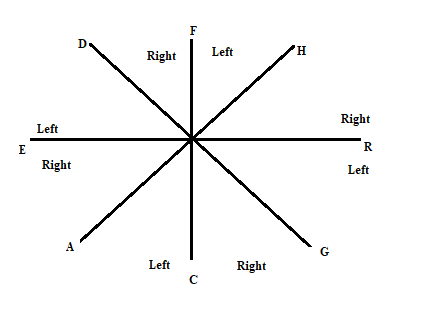
Q: The average age of seven persons sitting in a row facing east is 26 years. If the average age of the first three persons is 19 years and the average age of the last three persons is 32 years, then find the age of the person sitting in the middle of the row ? 3287 05b5cc6dce4d2b4197774e97e
5b5cc6dce4d2b4197774e97e- 132 yrsfalse
- 229 yrstrue
- 324 yrsfalse
- 427 yrsfalse
- Show AnswerHide Answer
- Workspace
- SingleChoice
Answer : 2. "29 yrs"
Explanation :
Answer: B) 29 yrs Explanation: Total age seven persons = (26 x 7)yearsTotal age of the first three persons and the last three persons are (19 x 3) years and (32 x 3) years respectively.Age of the person sitting in the middle of the row = 26 x 7 - 19 x 3 - 32 x 3 = 182 - 57 - 96 = 29 years.
Q: In how many different ways can the letters of the word 'NATIONAL' be arranged?
3286 05eb012adcaa4f678cf75b341
5eb012adcaa4f678cf75b341- 16720false
- 25040false
- 310080true
- 41020false
- 53360false
- Show AnswerHide Answer
- Workspace
- SingleChoice
Answer : 3. "10080 "
Q: What is the approximate circumference of earth?
3286 05e252df7643ee23eb6ae8bdf
5e252df7643ee23eb6ae8bdf- 170,000 Kmfalse
- 250,000 Kmfalse
- 340,000 Kmtrue
- 490,000 Kmfalse
- Show AnswerHide Answer
- Workspace
- SingleChoice
Answer : 3. "40,000 Km"
Explanation :
Using those measurements, the equatorial circumference of Earth is about 24,901 miles (40,075 km). However, from pole to pole — the meridional circumference — Earth is only 24,860 miles (40,008 km) around. Our planet's shape, caused by the flattening at the poles, is called an oblate spheroid.