


Practice Question and Answer
8 Q: In a certain code language, "SPARROW" is written as "1326654", and "RING" is written as "6978". How is "RAINS" written in that code language?
1341 062e7e7916f92bf0da7c48d73
62e7e7916f92bf0da7c48d73- 162917false
- 262977true
- 362971false
- 462972false
- Show AnswerHide Answer
- Workspace
- SingleChoice
Answer : 2. "62977"
Q: MIRV stands for-
1341 0651ead57cb11fc503612fa8c
651ead57cb11fc503612fa8c- 1Multi-directional Independently Reoriented Vehiclefalse
- 2Multipurpose Integrally Targeted Revolutionary Vechiclefalse
- 3Multiple Independently Targetable Reentry Vehicletrue
- 4Multidimensional Independent Re-entry Vehiclefalse
- Show AnswerHide Answer
- Workspace
- SingleChoice
Answer : 3. "Multiple Independently Targetable Reentry Vehicle"
Explanation :
Multiple Independently Targetable Reentry Vehicle (MIRV) warhead is a collection of separate warheads. By contrast a unitary warhead is a single warhead on a single missile.
Q:Direction: Below in each questions some sentences are given, find the sentence which is not really contributing to the main theme and the of the passage or find the odd sentence out and rearrange the remaining sentences to make a coherent paragraph. If the given sentence is correct as it is then choose option (e). If the sequence is the one which is not given then choose option (d) as your choice.
(A) As the LTTE displaced the other Tamil militias and became dominant, (B) To its ambition of a separate state (C)The abuses perpetrated by the warring actors (D) They boldly challenged its political choices, (E) Which, they felt, subordinated the well-being of the Tamil people
1341 064f6f28000fe54b9117e1564
64f6f28000fe54b9117e1564- 1CEDBfalse
- 2DABEfalse
- 3ADEBtrue
- 4None of thesefalse
- 5No correction requiredfalse
- Show AnswerHide Answer
- Workspace
- SingleChoice
Answer : 3. "ADEB"
Q:What should come in place of the question mark '?' in the following number series?
29, 30, 26, 35, ?, 44
1341 064edfbba3be218b6cddbe999
64edfbba3be218b6cddbe999- 131false
- 223false
- 327false
- 415false
- 519true
- Show AnswerHide Answer
- Workspace
- SingleChoice
Answer : 5. "19"
Q:Direction: Study the given pie chart carefully and answer the following questions accordingly. Given pie chart shows the percentage of players taking part in six different games in an event.
Total number of Players = 1800
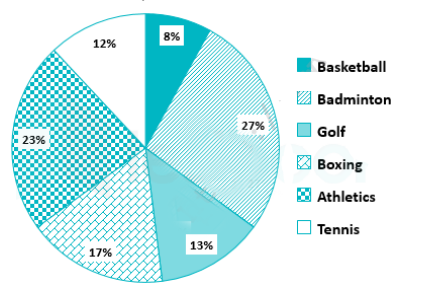
What is the respective ratio of the number of players taking part in Golf and the number of players taking part in Basketball?
1341 064e75e7546497acb22a19437
64e75e7546497acb22a19437- 18 : 13false
- 27 ∶ 13false
- 37 ∶ 26false
- 426 ∶ 7false
- 5None of thesetrue
- Show AnswerHide Answer
- Workspace
- SingleChoice
Answer : 5. "None of these"
Q: Who among the following developed the Cholera vaccine in 1885?
1341 064c21aa1a919c8488e0cbe42
64c21aa1a919c8488e0cbe42- 1Edward Jennerfalse
- 2Jaime Ferrántrue
- 3Jonas Salkfalse
- 4Leon Calmettefalse
- Show AnswerHide Answer
- Workspace
- SingleChoice
Answer : 2. "Jaime Ferrán"
Explanation :
1. The credit for developing the cholera vaccine in 1885 goes to Spanish-French bacteriologist and hygienist Jaime Ferrán.
2. He tested a live attenuated bacterial vaccine during a cholera epidemic in Valencia.
3. Jaime Ferrán's vaccine successfully protected people from cholera and began to be used in vaccination programs around the world.
- Show AnswerHide Answer
- Workspace
- SingleChoice
Answer : 1. "Oppida"
Q: A supermarket has sales of ₹1,48,500, ₹2,00,000, ₹1,64,000, ₹1,88,600 and ₹2,40,400 in 5 consecutive months. How much sales should the supermarket have in the 6th month so that the average sales for these 6 months become ₹1,88,300?
1341 0643d1ccf1ce944a93ea937b2
643d1ccf1ce944a93ea937b2- 1₹2,00,500false
- 2₹1,88,300true
- 3₹1,64,000false
- 4₹1,90,020false
- Show AnswerHide Answer
- Workspace
- SingleChoice