


Practice Question and Answer
8 Q: Which actor and popular mimicry artist has passed away at the age of 68?
1067 060f12b782b1d3266fda649a9
60f12b782b1d3266fda649a9- 1Mehak Khatrifalse
- 2Madhav Moghetrue
- 3Chetan Chauhanfalse
- 4Jaswant Singhfalse
- Show AnswerHide Answer
- Workspace
- SingleChoice
Answer : 2. "Madhav Moghe"
Q: Himalaya Day is celebrated on which of the following days?
1067 1613f4562512b7a072f8f431d
613f4562512b7a072f8f431d- 1January 10false
- 29 septembertrue
- 312 Marchfalse
- 45 augustfalse
- Show AnswerHide Answer
- Workspace
- SingleChoice
Answer : 2. "9 september"
Q:Directions: Read the following passage carefully and answer the questions given below it. Certain words have been printed in bold to help you locate them, while answering some of the questions.
Among those suffering from the global recession are millions of workers who are not even included in the official statistics : urban recyclers – the trash pickers, sorters, traders and reprocesses who extricate paper, cardboard and plastics from garbage heaps and prepare them for reuse. Their work is both unrecorded and largely unrecognized, even though in some parts of the World they handle as much as 20% of all waste.
The World’s 15 million informal recyclers clean up cities, prevent some trash from ending in landfills and thus, reduce climate change by saving energy on waste disposal techniques like incineration. In the developed countries they are the preferred ones since they recycle waste much more cheaply and efficiently than governments or private corporations can. In the developing World, on the other hand, they provide the only recycling services except for a few big cities. But as recession hits the markets Worldwide, the price of scrap metal, paper and plastic has also fallen. Recyclers throughout the World are experiencing a sharp drop in income. Trash pickers and scrap dealers saw a decline of as much as 80% in the price of scrap from October 2007 to October 2009. In some countries scrap dealers have shuttered so quickly that researchers at the Solid Waste Management Association didn’t have a chance to record their losses. In Delhi, some 80% of families in the informal recycling business surveyed by an organization said they had cut back on “luxury foods,” which they defined as fruit, milk and meat. About 41% had stopped buying milk for their children. By this summer, most of those children, already malnourished, hadn’t had a glass of milk in nine months. Many of these children have also cut down on hours spent in school to work alongside their parents. Families have liquidated their most valuable assets – primarily copper from electrical wires – and have stopped sending remittances back to their rural villages. Many have also sold their emergency stores of grain. Their misery is not as familiar as that of the laid-off workers of big name but imploding, service sector corporation, but it is often more tragic. Few countries have adopted emergency measures to help trash pickers. Brazil, for one, is providing recyclers, or “catadores,” with cheaper food, both through arrangements with local farmers and by offering food subsidies. Other countries, with the support of non-governmental organizations and donor agencies are following Brazil’s example. Unfortunately, most trash pickers operate outside official notice and end up falling through the cracks of programmes like these. In the long run, though, these invisible workers will remain especially vulnerable to economic slowdowns unless they are integrated into the formal business sector, where they can have insurance and reliable wages. This is not hard to accomplish. Informal junk shops should have to apply for licences, and governments should create or expand doorstep waste collection programmes to employ trash pickers. Instead of sorting through haphazard trash heaps and landfills, the pickers would have access to the cleaner scrap that comes from households.
The need of the hour, however, is a more immediate solution. An efficient but temporary solution would be for governments where they’d have to pay a small subsidy to waste dealers so they could purchase scrap from trash pickers at about 20% above the current price. This increase, if well advertised and broadky utilized, would bring recyclers a higher price and eventually bring them back from the brink. Trash pickers make our cities healthier and more liveable. We all stand to gain by making sure that the work of recycling remains sustainable for years to come.
Which of the following is not true in the context of the passage?
1067 0618a087e9236c01fbea86138
618a087e9236c01fbea86138Among those suffering from the global recession are millions of workers who are not even included in the official statistics : urban recyclers – the trash pickers, sorters, traders and reprocesses who extricate paper, cardboard and plastics from garbage heaps and prepare them for reuse. Their work is both unrecorded and largely unrecognized, even though in some parts of the World they handle as much as 20% of all waste.
The World’s 15 million informal recyclers clean up cities, prevent some trash from ending in landfills and thus, reduce climate change by saving energy on waste disposal techniques like incineration. In the developed countries they are the preferred ones since they recycle waste much more cheaply and efficiently than governments or private corporations can. In the developing World, on the other hand, they provide the only recycling services except for a few big cities. But as recession hits the markets Worldwide, the price of scrap metal, paper and plastic has also fallen. Recyclers throughout the World are experiencing a sharp drop in income. Trash pickers and scrap dealers saw a decline of as much as 80% in the price of scrap from October 2007 to October 2009. In some countries scrap dealers have shuttered so quickly that researchers at the Solid Waste Management Association didn’t have a chance to record their losses. In Delhi, some 80% of families in the informal recycling business surveyed by an organization said they had cut back on “luxury foods,” which they defined as fruit, milk and meat. About 41% had stopped buying milk for their children. By this summer, most of those children, already malnourished, hadn’t had a glass of milk in nine months. Many of these children have also cut down on hours spent in school to work alongside their parents. Families have liquidated their most valuable assets – primarily copper from electrical wires – and have stopped sending remittances back to their rural villages. Many have also sold their emergency stores of grain. Their misery is not as familiar as that of the laid-off workers of big name but imploding, service sector corporation, but it is often more tragic. Few countries have adopted emergency measures to help trash pickers. Brazil, for one, is providing recyclers, or “catadores,” with cheaper food, both through arrangements with local farmers and by offering food subsidies. Other countries, with the support of non-governmental organizations and donor agencies are following Brazil’s example. Unfortunately, most trash pickers operate outside official notice and end up falling through the cracks of programmes like these. In the long run, though, these invisible workers will remain especially vulnerable to economic slowdowns unless they are integrated into the formal business sector, where they can have insurance and reliable wages. This is not hard to accomplish. Informal junk shops should have to apply for licences, and governments should create or expand doorstep waste collection programmes to employ trash pickers. Instead of sorting through haphazard trash heaps and landfills, the pickers would have access to the cleaner scrap that comes from households.
- 1Purchase of trash at a higher price by the government is only a temporary solution to the larger problem.false
- 2The welfare programs started by the government for the recyclers largely fail to help them.false
- 3In the last couple of years the price of scrap has come down to 20% of its original price.true
- 4Few countries have started to take steps against the plight of the recyclers.false
- 5All the truefalse
- Show AnswerHide Answer
- Workspace
- SingleChoice
Answer : 3. "In the last couple of years the price of scrap has come down to 20% of its original price."
Q: Which one of the following costs more?
I. 200 packets of ₹ 250 each
II . 20 dozens of ₹ 250 each
1067 0622b2fe57c4208076bab6480
622b2fe57c4208076bab6480- 1Ifalse
- 2IItrue
- 3Both I and II are equalfalse
- 4Cannot be calculatedfalse
- Show AnswerHide Answer
- Workspace
- SingleChoice
Answer : 2. "II"
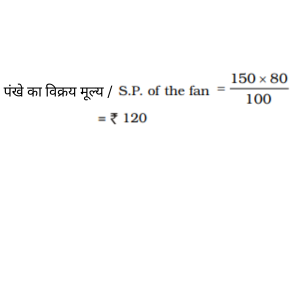
Q: A fan is listed at ₹ 150 and a discount of 20% is given. Then the selling price is
1067 06246cec8e6c50b4b29b7fe44
6246cec8e6c50b4b29b7fe44- 1₹ 120true
- 2₹ 110false
- 3₹ 180false
- 4₹ 150false
- Show AnswerHide Answer
- Workspace
- SingleChoice
Answer : 1. "₹ 120 "
Explanation :
Q: Who is the author of the book ‘Gone Girl’?
1067 06419b7d0fb0ff69a8ee9a1aa
6419b7d0fb0ff69a8ee9a1aa- 1Damon Galgutfalse
- 2Gillian Flynntrue
- 3Yann Martelfalse
- 4Anna Burnsfalse
- Show AnswerHide Answer
- Workspace
- SingleChoice
Answer : 2. "Gillian Flynn"
Q: Who was the Ruler of Jaipur state when treaties were signed with British in 1818?
1067 062e14de355271b3503351460
62e14de355271b3503351460- 1Maharaja Mann Singhfalse
- 2Maharana Bhim Singhfalse
- 3Rao Vishnu Singhfalse
- 4Sawai Jagat Singhtrue
- Show AnswerHide Answer
- Workspace
- SingleChoice
Answer : 4. "Sawai Jagat Singh "
Q: Which Section of the Rajasthan Panchayati Raj Act, 1994 has been amended to substitute the expression Village Development Officer for Gram Sevak?
1067 062f0f27355c5be584100968a
62f0f27355c5be584100968a- 191false
- 289true
- 392false
- 488false
- Show AnswerHide Answer
- Workspace
- SingleChoice
Answer : 2. "89"
Explanation :
1. Section 89 of the Rajasthan Panchayati Raj Act, 1994 provides for the constitution of Rajasthan Panchayat Samiti and Zilla Parishad Service.
2. The amendment to section 89 states that the expression “Village Development Officer” shall be substituted for the existing expression “Village-level worker/Gram Sevak”.
3. The post of Gram Sevaks under Section 89 does not exist in Panchayati Raj Institutions and hence the existing provisions are deleted.
4. The Rajasthan Panchayati Raj Act, 1994 came into force in the state on April 23, 1994.