Practice Question and Answer

Q:

Directions: Study the Bar diagram carefully and answer the questions. 

The Bar diagram shows the trends of foreign direct investment (FDI) into India from all over the World (in Rs. crores). 
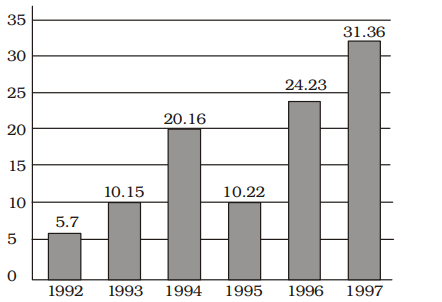
 

The ratio of investment in 1997 to the average investment is 

1097 0

  • 1
    2 : 1
    Correct
    Wrong
  • 2
    1 : 2
    Correct
    Wrong
  • 3
    1 : 1
    Correct
    Wrong
  • 4
    3 : 1
    Correct
    Wrong
  • Show AnswerHide Answer
  • Workspace

Answer : 1. "2 : 1"

Q:

Directions: Read the following passage carefully and choose the best answer to each question out of the four alternatives.

The most logical and intelligent people seem to go berserk when talking about snakes. Recently a reputed scientist said with a wise look in his eyes that sand boas have two heads. The other day someone walked into my office and stated that in his village at least cobras mate with rat snakes. About other places he was not sure, he added modestly, but that was how it was in his village.

These stories about snakes are myths. Sand boas have only one head; vine snakes do not peck your eyes out; no snake will drink milk. But it is interesting to try and trace the origin of these untruths. The one about the sand boas two heads obviously exists because the short, stumpy tail of this snake looks remarkably like the head, an effective device to fool predators. Or take the one about vine snakes pecking at eyes. It was ‘probably started by a vine snake that had a bad aim, as snakes, when provoked, will bite the most prominent projection of the offender, which is usually the nose.

But the most interesting one is about snakes coming to the scene of killing to take revenge. It so happens that when injured or under stress, a snake exudes, a large quantity of musk. Musk is a powerful sex attractant, the snakes’ equivalent of after-shave lotion. So after a snake is killed, the ground around still has this smell and naturally a snake of the same species passing by will lick its lips and come to investigate. The killer of the snake, who is probably worried if the pooja he performed was adequate to liquidate the killing of a snake, sees the second snake and is convinced that it was not.

The Irula tribals have a good answer to the query about whether cobras have jewels in their heads; “If they did, we wouldn’t be snake catchers, we would be rajas!”

According to the passage, the author

1097 0

  • 1
    believes in myths.
    Correct
    Wrong
  • 2
    is afraid of snakes.
    Correct
    Wrong
  • 3
    worships snakes.
    Correct
    Wrong
  • 4
    believes in facts.
    Correct
    Wrong
  • Show AnswerHide Answer
  • Workspace

Answer : 4. "believes in facts."

Q:

Which of the following competition for teachers is organized by 'Rajasthan Board of Secondary Education, Ajmer?

1097 0

  • 1
    Painting
    Correct
    Wrong
  • 2
    Sports
    Correct
    Wrong
  • 3
    Quiz
    Correct
    Wrong
  • 4
    Pedagogy (Teaching)
    Correct
    Wrong
  • Show AnswerHide Answer
  • Workspace

Answer : 4. "Pedagogy (Teaching)"

Q:

What is the value of [ 7÷ 14 x 8 + (5 ÷ 15 x 6 - 4 × 3)]?

1097 0

  • 1
    - 4
    Correct
    Wrong
  • 2
    - 2
    Correct
    Wrong
  • 3
    - 6
    Correct
    Wrong
  • 4
    - 5
    Correct
    Wrong
  • Show AnswerHide Answer
  • Workspace

Answer : 3. "- 6 "

Q:

Read the given passage and answer the questions that follow.

Chanhudaro was a tiny settlement (less than 7 hectares) as compared to Mohenjodaro (125 hectares), almost exclusively devoted to craft production, including bead-making, shellcutting, metal-working, seal-making and weight-making. The variety of materials used to make beads is remarkable: stones like carnelian (of a beautiful red colour), jasper, crystal, quartz and steatite; metals like copper, bronze and gold; and shell, faience and terracotta or burnt clay. Some beads were made of two or more stones, cemented together, some of stone with gold caps. The shapes were numerous – disc shaped, cylindrical, spherical, barrel-shaped, segmented. Some were decorated by incising or painting, and some had designs etched onto them.

Techniques for making beads differed according to the material. Steatite, a very soft stone, was easily worked. Some beads were moulded out of a paste made with steatite powder. This permitted making a variety of shapes, unlike the geometrical forms made out of harder stones. How the steatite micro bead was made remains a puzzle for archaeologists studying ancient technology. Archaeologists’ experiments have revealed that the red colour of carnelian was obtained by firing the yellowish raw material and beads at various stages of production. Nodules were chipped into rough shapes, and then finely flaked into the final form. Grinding, polishing and finally drilling completed the process. Specialised drills have been found at Chanhudaro, Lothal and more recently at Dholavira. Nageshwar and Balakot, both settlements are near the coast. These were specialised centres for making shell objects – including bangles, ladles and inlay – which were taken to other settlements. Similarly, it is likely that finished products (such as beads) from Chanhudaro and Lothal were taken to the large urban centres such as Mohenjodaro and Harappa.

Which is the final process in the production of beads?

1097 0

  • 1
    Polishing
    Correct
    Wrong
  • 2
    Drilling
    Correct
    Wrong
  • 3
    Grinding
    Correct
    Wrong
  • 4
    Chipping
    Correct
    Wrong
  • Show AnswerHide Answer
  • Workspace

Answer : 2. "Drilling"

Q:

Which scheme has been approved by the Union Cabinet to improve the working style of government officials?

1097 0

  • 1
    Karmaveer Yojana
    Correct
    Wrong
  • 2
    majestic scheme
    Correct
    Wrong
  • 3
    Karmayogi Scheme
    Correct
    Wrong
  • 4
    Style Development Plan
    Correct
    Wrong
  • Show AnswerHide Answer
  • Workspace

Answer : 3. "Karmayogi Scheme"

      Report Error

    Please Enter Message
    Error Reported Successfully

      Report Error

    Please Enter Message
    Error Reported Successfully

      Report Error

    Please Enter Message
    Error Reported Successfully

      Report Error

    Please Enter Message
    Error Reported Successfully

      Report Error

    Please Enter Message
    Error Reported Successfully

      Report Error

    Please Enter Message
    Error Reported Successfully

      Report Error

    Please Enter Message
    Error Reported Successfully

      Report Error

    Please Enter Message
    Error Reported Successfully