Practice Question and Answer

Q:

Directions : Study the following bar graph and answer the questions.

company (in lakhs of rupees) for the years 1994-1997:
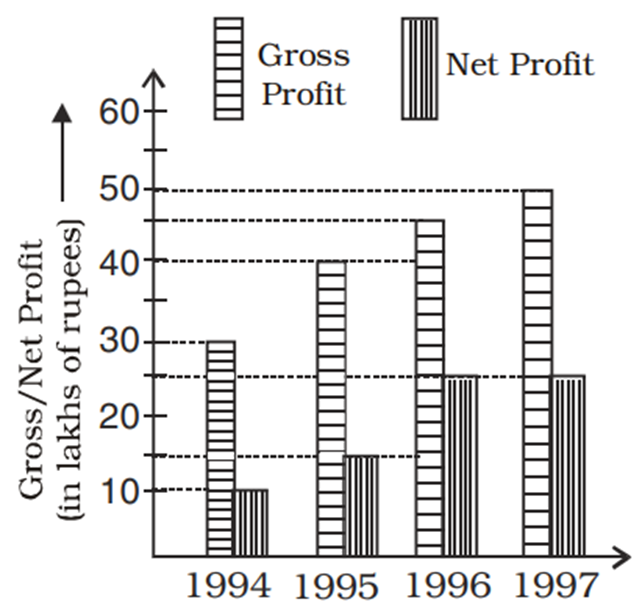
The ratio of gross profit to net profit in a year was greatest in the year

620 0

  • 1
    1994
    Correct
    Wrong
  • 2
    1995
    Correct
    Wrong
  • 3
    1996
    Correct
    Wrong
  • 4
    1997
    Correct
    Wrong
  • Show AnswerHide Answer
  • Workspace

Answer : 1. "1994 "

Q:

On a rainy day, 60 cm of rain is recorded in a region. What is the volume of water collected in an open and empty rectangular water tank that measures 12 m (length) ×10 m (width) and 50 cm (depth)?

620 0

  • 1

    120 m3

    Correct
    Wrong
  • 2

    72 m3

    Correct
    Wrong
  • 3

    60 m3 

    Correct
    Wrong
  • 4

    48 m3

    Correct
    Wrong
  • Show AnswerHide Answer
  • Workspace

Answer : 3. "

60 m3 

"

Q:

In a certain code language, 'DENTIST' is written as ‘CDMSHRS’ and ‘TOOTH’ is written as ‘SNNSG’, how will 'HEALING' be written in that language?

620 0

  • 1
    IFBMJOH
    Correct
    Wrong
  • 2
    GDZMJOH
    Correct
    Wrong
  • 3
    IFBKHMF
    Correct
    Wrong
  • 4
    GDZKHMF
    Correct
    Wrong
  • Show AnswerHide Answer
  • Workspace

Answer : 4. "GDZKHMF"

  • Show AnswerHide Answer
  • Workspace

Answer : 3. "$$3 {1\over 3}$$ %"

Q:

Read the following passage and answer the questions given after it

Amidst a maze of rocks tucked in the Aravalli mountain ranges of Haryana, a team of archaeologists discovered cave paintings they believe belong to the Upper Palaeolithic age. The cave paintings have been discovered just outside the national capital and a stone’s throw away from a holy grove called Mangar Bani- the region’s only surviving patch of primary forest.

While the residents of the villages have been familiar with the paintings for ages, the Haryana government’s museum and archaeology department took note of them just recently. A fact-finding team was sent to the area in the last week of June. The team came across cave paintings comprising images of human figurines, animals, foliage, and geometric drawings. While some have paled over time, others are still very visible. They also discovered rock art and open-air ceremonial sites.

Banani Bhattacharyya, deputy director of the department of archaeology and museums informed, “So far, cave paintings in Delhi-NCR have only been found here. The paintings are yet to be dated but at least some of them belong to the Upper Palaeolithic period in all likelihood. We are viewing the paintings in continuation with the Soanian culture which has been found in Shivalik hills, Narmada and Aravallis.”

Most of the cave paintings found were in ochre colour, but some were in white. As per experts, cave paintings in white are usually from a later stage (early contemporary era), while Stone Age paintings are more often than not in ochre. “Stone age paintings generally use red and ochre colours. Stones of these colour used to be available locally and inhabitants crushed the stones for preparing the colour for paintings,” added Bhattacharyya

The Upper Paleolithic Age began around 40,000 years ago and lasted till around 10,000 years ago. While yet to be established through archaeological dating, Bhattacharyya says the Mangar cave art is 20,000-40,000 years old. Bhattacharyya claimed that the discovery is extremely significant. “Starting from the Lower Palaeolithic to Middle Palaeolithic then Upper Palaeolithic, we see the evolution here. We have found significant remains from Lower Palaeolithic till Middle and Upper Palaeolithic period too,” she explained. “Though tools from the Palaeolithic Age have been identified earlier in parts of the Aravallis, it is for the first time that cave paintings and rock art of a large magnitude have been found in Haryana,” she added.

The archaeological findings in the Mangar Forest consist of all the following except

620 0

  • 1
    tools
    Correct
    Wrong
  • 2
    ceremonial sites
    Correct
    Wrong
  • 3
    cave paintings
    Correct
    Wrong
  • 4
    rock art
    Correct
    Wrong
  • Show AnswerHide Answer
  • Workspace

Answer : 1. "tools"

Q:

Read the following passage and answer the questions given after it.

The Celts who lived in Britain before the Roman invasion of 43 AD could be said to have created the first towns. Celts in southern England lived in hill forts, which were quite large settlements. (Some probably had thousands of inhabitants). They were places of trade, where people bought and sold goods and also places where craftsmen worked. The Romans called them oppida.

However, the Romans created the first settlements that were undoubtedly towns. Roman towns were usually laid out in a grid pattern. In the centre was the forum or market place. It was lined with public buildings. Life in Roman towns was highly civilized with public baths and temples.

From the 5th century Angles, Saxons and Jutes invaded England. At first, the invaders avoided living in towns. However, as trade grew some towns grew up. London revived by the 7th century (although the Saxon town was, at first, outside the walls of the old Roman town). Southampton was founded at the end of the 7th century. Hereford was founded in the 8th century. Furthermore, Ipswich grew up in the 8th century and York revived. However, towns were rare in Saxon England until the late 9th century. At that time, Alfred the Great created a network of fortified settlements across his kingdom called ‘burhs’. In the event of a Danish attack, men could gather in the local burh. However, burhs were more than forts. They were also market towns. Some burhs were started from scratch but many were created out of the ruins of old Roman towns. Places like Winchester rose, phoenix-like, from the ashes of history.

The thing that would strike us most about medieval towns would be their small size. Winchester, the capital of England, probably had about 8,000 people. At that time a 'large' town, like Lincoln or Dublin had about 4,000 or 5,000 inhabitants and a 'medium sized' town, like Colchester had about 2,500 people. Many towns were much smaller. However, during the 12th and 13th centuries most towns grew much larger. Furthermore, many new towns were created across Britain. Trade and commerce were increasing and there was a need for new towns. Some were created from existing villages but some were created from scratch. In those days you could create a town simply by starting a market. There were few shops so if you wished to buy or sell anything you had to go to a market. Once one was up and running, craftsmen and merchants would come to live in the area and a town would grow.

“At first, the invaders avoided living in towns.” Who is/are being referred to here as ‘invaders’?

620 0

  • 1
    Saxons, Angles and Jutes
    Correct
    Wrong
  • 2
    Alfred the Great
    Correct
    Wrong
  • 3
    Celts
    Correct
    Wrong
  • 4
    Romans
    Correct
    Wrong
  • Show AnswerHide Answer
  • Workspace

Answer : 1. "Saxons, Angles and Jutes"

Q:

Complete the phrasal verb in the following sentence:
 I usually go to bed early and also get ………… early. 

619 0

  • 1
    out
    Correct
    Wrong
  • 2
    off
    Correct
    Wrong
  • 3
    up
    Correct
    Wrong
  • 4
    into
    Correct
    Wrong
  • Show AnswerHide Answer
  • Workspace

Answer : 3. "up "

      Report Error

    Please Enter Message
    Error Reported Successfully

      Report Error

    Please Enter Message
    Error Reported Successfully

      Report Error

    Please Enter Message
    Error Reported Successfully

      Report Error

    Please Enter Message
    Error Reported Successfully

      Report Error

    Please Enter Message
    Error Reported Successfully

      Report Error

    Please Enter Message
    Error Reported Successfully

      Report Error

    Please Enter Message
    Error Reported Successfully

      Report Error

    Please Enter Message
    Error Reported Successfully