Practice Question and Answer
8 Q: Each sentence below has a blank and each blank indicates that something has been omitted. Choose the word that best fits in meaning of the sentence as a whole.
Raj was___ introvert and would prefer to sit in the library rather than go out with friend’s birthday.
2722 05d4942952ef8ad44d16189cf
5d4942952ef8ad44d16189cfRaj was___ introvert and would prefer to sit in the library rather than go out with friend’s birthday.
- 1thefalse
- 2afalse
- 3likefalse
- 4forfalse
- 5antrue
- Show AnswerHide Answer
- Workspace
- SingleChoice
Answer : 5. "an"
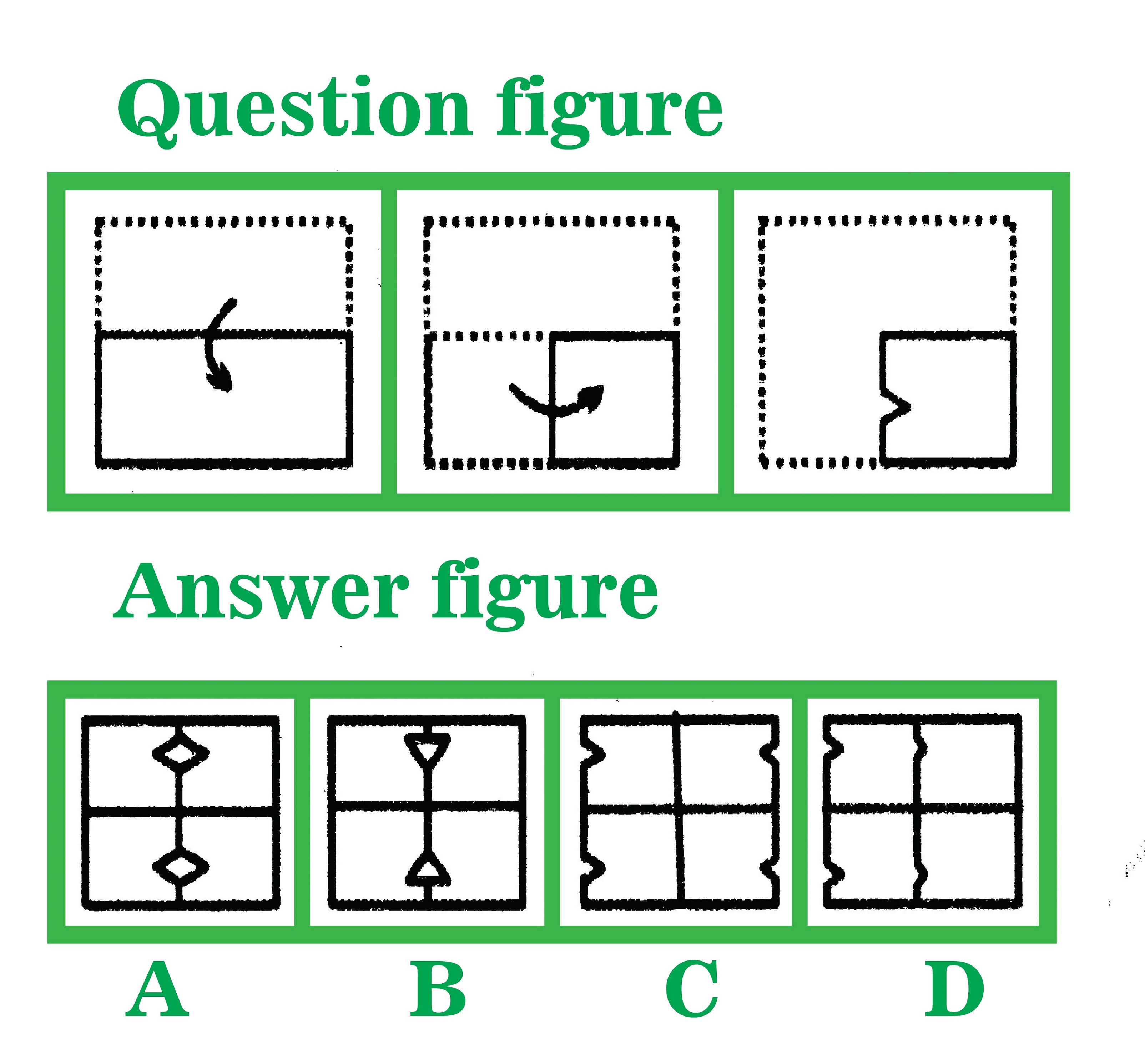
Q: Select the cube that can be formed by folding the given sheet along the lines.

2721 164c7a4f2a4dbfb486bdb2e89
64c7a4f2a4dbfb486bdb2e89- 1Only Dfalse
- 2Only A and Cfalse
- 3Only C and Dtrue
- 4Only Bfalse
- Show AnswerHide Answer
- Workspace
- SingleChoice
Answer : 3. "Only C and D"
Q: 12 pumps working 6 hours a day can empty a completely filled reservoir in 15 days. How many such pumps working 9 hours a day will empty the same reservoir in 12 days?
2721 15d70e6f7eb96471d6f369878
5d70e6f7eb96471d6f369878- 115false
- 29false
- 310true
- 412false
- Show AnswerHide Answer
- Workspace
- SingleChoice
Answer : 3. "10"
Q: An examination of dead body? 2721 25d14aecd489f2f135e08e4c3
5d14aecd489f2f135e08e4c3- 1Ante-mortemfalse
- 2Autopsytrue
- 3Morguefalse
- 4Cremationfalse
- Show AnswerHide Answer
- Workspace
- SingleChoice
Answer : 2. "Autopsy"
Q: In the following question, a word is represented by only one set of numbers as given in any one of the alternatives. The sets of number given in the alternatives are represented by two classes of alphabets as in the 2 matrices given below. The columns and rows of Matrix-I are numbered from 0 to 4 and that of Matrix-II from 5 to 9. A letter from these matrices can be represented first by its row and next by column number. For example, 'W' can be represented by 13, 20 etc, 'H' can be represented by 66, 78 etc. Identify the set of the word PENS.


2721 05d7f778bb4835d15d81fcd62
5d7f778bb4835d15d81fcd62

- 112, 67, 21, 30false
- 243, 56, 13, 23false
- 343, 56, 21, 42true
- 431, 57, 21, 42false
- Show AnswerHide Answer
- Workspace
- SingleChoice
Answer : 3. "43, 56, 21, 42"
Q:Direction (1-6): Read the passage carefully then answer the questions given below. People have long circulated news via word-of-mouth, and as language evolved into writing and literacy – and governments played larger roles in people’s lives – sharing information became a necessity. However, disseminating news and information on paper presented significant challenges. When each copy had to be handwritten, mass distribution was impossible. They were first chiseled in stone or metal; later, they were handwritten and distributed in public forums or read from scrolls by town criers. Though both ancient Romans and Chinese – as well as other ancient civilizations – had early forms of news media, they do not qualify as newspapers because they could not be mass-distributed.
The first true newspapers arrived after Johannes Gutenberg introduced his movable type printing press to the European world around 1440. Though printing presses with movable type had existed in eastern Asia for around two centuries, they never made it to Europe; furthermore, Gutenberg’s version made it significantly faster to mass produce documents. By 1500, the printing press had made its way throughout Europe, and news sheets (or news books) were mass-distributed.
The first weekly newspaper was published in Germany by Johann Carolus in 1604. Called Relation aller Fürnemmen und gedenckwürdigen Historien, the publication satisfied the four tenets of a “true” newspaper: Accessibility by the public, Published at a regular interval (daily, weekly, monthly, etc.) ,Information is current ,Covers a variety of topics (politics, events, entertainment, sports, etc.) Despite meeting the requirements for a newspaper, there is some debate as to whether The Relation qualifies as the world’s first newspaper since it was printed in quarto, not folio, size. It’s worth noting the World Association of Newspapers considers The Relation the first true newspaper.’
Other German newspapers followed, and in 1618 the world’s first broadsheet newspaper printed in folio size was published in Amsterdam, called Courante uyt Italien, Duytslandt, &c. The newspaper format soon spread throughout Europe, with newspapers published in Spain, France, and Sweden. The first English newspaper was published in 1665 in Oxford, England. Known as the Oxford Gazette, the newspaper moved to London in 1666 and was renamed the London Gazette. It’s still being published today. Soon after, the newspaper became a staple in all major European countries. It then made its way to the New World.
Which of the following options is satisfying the condition for being a tenant of a “true newspaper”?
2720 06038cb7b24cd273bc4f9c106
6038cb7b24cd273bc4f9c106The first true newspapers arrived after Johannes Gutenberg introduced his movable type printing press to the European world around 1440. Though printing presses with movable type had existed in eastern Asia for around two centuries, they never made it to Europe; furthermore, Gutenberg’s version made it significantly faster to mass produce documents. By 1500, the printing press had made its way throughout Europe, and news sheets (or news books) were mass-distributed.
The first weekly newspaper was published in Germany by Johann Carolus in 1604. Called Relation aller Fürnemmen und gedenckwürdigen Historien, the publication satisfied the four tenets of a “true” newspaper: Accessibility by the public, Published at a regular interval (daily, weekly, monthly, etc.) ,Information is current ,Covers a variety of topics (politics, events, entertainment, sports, etc.) Despite meeting the requirements for a newspaper, there is some debate as to whether The Relation qualifies as the world’s first newspaper since it was printed in quarto, not folio, size. It’s worth noting the World Association of Newspapers considers The Relation the first true newspaper.’
Other German newspapers followed, and in 1618 the world’s first broadsheet newspaper printed in folio size was published in Amsterdam, called Courante uyt Italien, Duytslandt, &c. The newspaper format soon spread throughout Europe, with newspapers published in Spain, France, and Sweden. The first English newspaper was published in 1665 in Oxford, England. Known as the Oxford Gazette, the newspaper moved to London in 1666 and was renamed the London Gazette. It’s still being published today. Soon after, the newspaper became a staple in all major European countries. It then made its way to the New World.
- 1A newspaper which was printed in quarto, not folio, sizefalse
- 2A newspaper which covers historic developments leading to various events.false
- 3A newspaper which is accessible to only Asian readers.false
- 4A newspaper which was published once in a month.true
- 5A newspaper which is printed in press and is not handwrittenfalse
- Show AnswerHide Answer
- Workspace
- SingleChoice
Answer : 4. "A newspaper which was published once in a month. "
Q: Constitution of India was adopted by constituent assembly on 2720 05c2c69a29fd00135a4b20e7c
5c2c69a29fd00135a4b20e7c- 125 october, 1948false
- 225 october 1949false
- 326 november 1948false
- 426 november 1949true
- Show AnswerHide Answer
- Workspace
- SingleChoice
Answer : 4. "26 november 1949"
Q: Which of the following statements about water is false? 2720 05b5cc601e4d2b4197774b462
5b5cc601e4d2b4197774b462- 1There is extensive intramolecular hydrogen bonding in the condensed phase.true
- 2Water is oxidized to oxygen during photosynthesis.false
- 3Ice formed by heavy water sinks in normal water.false
- 4Water can act both as an acid and as a base.false
- Show AnswerHide Answer
- Workspace
- SingleChoice
Answer : 1. "There is extensive intramolecular hydrogen bonding in the condensed phase."
Explanation :
Answer: A) There is extensive intramolecular hydrogen bonding in the condensed phase. Explanation: Water possess intermolecular hydrogen bonding in the condensed phase. Hence, the given statement 'There is extensive intramolecular hydrogen bonding in the condensed phase.' about water is FALSE.