


Practice Question and Answer
8- Show AnswerHide Answer
- Workspace
- SingleChoice
Answer : 4. "Someone who spends too much time on social websites"
Q:Directions: Study the following information carefully and answer the questions below.
Eight people- A, B, C, D, W, X, Y and Z are sitting in a circle facing the centre. All eight people are from different place i.e. Okhla, Dwarka, Lajpat Nagar, Chanakyapuri, Saket, Mehrauli, Rohini and Karol Bagh but not necessarily in the same order.
W is sitting third to the left of Y. The person who is from Dwarka is to the immediate right of W and W is not from Okhla. B is sitting fourth to the right of Z. Z is not the neighbour of Y. Neither B nor Z is an immediate neighbour of W. X is from Chanakyapuriand is sitting third to the right of the person from Dwarka. The person from Mehrauli is sitting second to the left of the person from Chanakyapuri. The person from Rohini is sitting second to the left of W. A who is Lajpat Nagar is sitting exactly between X and Z. The person from Saket is sitting second to the right of the person from Lajpat Nagar. C is sitting third to the left of X.
What is A’s position with respect to B?
551 064edd5fe2bbb242750d5d7db
64edd5fe2bbb242750d5d7db- 1Third to the righttrue
- 2Second to the rightfalse
- 3Third to the leftfalse
- 4Second to the leftfalse
- 5Fourth to the rightfalse
- Show AnswerHide Answer
- Workspace
- SingleChoice
Answer : 1. "Third to the right"
- Show AnswerHide Answer
- Workspace
- SingleChoice
Answer : 4. "both (a) and (b)"
Q: 'पानी में आग लगाना' मुहावरे का भावार्थ है-
550 063a1b2d936fed95f3e031044
63a1b2d936fed95f3e031044- 1असंभव कार्य करने का प्रयास करनाfalse
- 2पागलपन के काम करनाfalse
- 3जहाँ झगड़ा होना असंभव हो, वहाँ झगड़ा करवा देनाtrue
- 4लीक से हटकर कोई काम करनाfalse
- Show AnswerHide Answer
- Workspace
- SingleChoice
Answer : 3. "जहाँ झगड़ा होना असंभव हो, वहाँ झगड़ा करवा देना"
Q:Directions : Given here is a pie chart showing the cost of gold in 2010, 2011, 2012 and 2013. Study the chart and answer the following questions
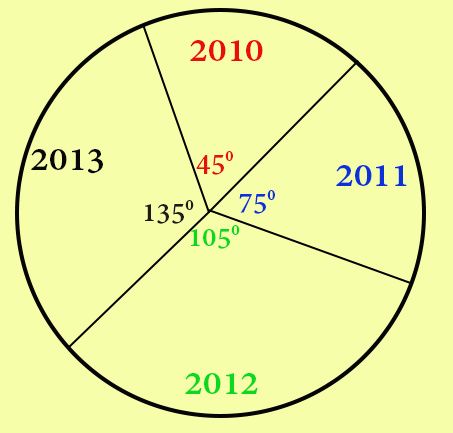
The ratio of percentage increases in price of gold from 2011 to 2012 and 2012 to 2013 is
550 064539f4739143d085f3e3c04
64539f4739143d085f3e3c04- 16 : 5false
- 27 : 5true
- 38 : 5false
- 49 : 5false
- Show AnswerHide Answer
- Workspace
- SingleChoice
Answer : 2. "7 : 5"
Q:Select the odd group of numbers. (NOTE: Operations should be performed on the whole numbers, without breaking down the numbers into its constituent digits. E.g.13 – Operations on 13 such as adding /subtracting /multiplying etc. to 13 can be performed. Breaking down 13 into 1 and 3 and then performing mathematical operations on 1 and 3 is not allowed)
Option
550 06489a49db50f5316a45e0364
6489a49db50f5316a45e0364- 16 – 60false
- 22 – 18true
- 34 – 40false
- 48 – 80false
- Show AnswerHide Answer
- Workspace
- SingleChoice
Answer : 2. "2 – 18"
Q:Read the following passage and answer the questions given after it.
The stark observation made in the Economic Survey of 2015-16 that “Indian agriculture, is in a way, a victim of its own past success – especially the green revolution”, shows the dark reality of the agriculture sector at present and the havoc that has been wreaked by the green revolution.
The green revolution, which is often characterised by the introduction of high-yielding variety of seeds and fertilisers, undoubtedly increased the productivity of land considerably. But the growth in the productivity has been stagnant in recent years, resulting in a significant decline in the income of farmers. There have also been negative environmental effects in the form of depleting water table, emission of greenhouse gases, and the contamination of surface and ground water. Needless to say, the agriculture sector is in a state of distress, which is severely affecting peasants and marginal farmers, and urgent policy interventions are required to protect their interests.
The government has responded to the problem by constituting a panel, which will recommend ways to double the income of farmers by 2022. While this may be an overtly ambitious target, if we want to boost stagnated agricultural growth a shift has to be made from food security of the nation to income security of the farmers. However, there are many hurdles that have to be crossed if we want to achieve this objective.
The first major barrier to overcome is declining productivity. Data from 2013 reveals that India’s average yield of cereal per hectare is far less than that of many countries (including several low income countries), but the difference is huge when compared to China. For instance, our average yield per hectare is 39% below than that of China and for rice this figure is 46%. Even Bangladesh, Vietnam and Indonesia fare better than India in case of rice yield. Further, there is a huge inter-regional variation; the wheat and rice yield from Haryana and Punjab is much higher than from the other states.
In order to cross the declining productivity barrier there is a need to herald a rainbow revolution by making a shift from wheat-rice cycle to other cereals and pulses. Since wheat and rice coupled with other crops are backed by minimum support prices (MSP) and input subsidy (whether water, fertiliser or power) regime, there is a huge incentive for the farmers in the irrigated region of Northwest India to grow these crops.
What does the author suggest to enhance the income of the farmers?
550 064c8defc29beb3482a4ae801
64c8defc29beb3482a4ae801- 1Constitute a panel to suggest ways to double the incomefalse
- 2Provide income security to the farmerstrue
- 3Give subsidies on water, fertilizers and powerfalse
- 4Shift wheat-rice cycle to include other cereals and pulsesfalse
- Show AnswerHide Answer
- Workspace
- SingleChoice
Answer : 2. "Provide income security to the farmers"
Q:Directions: Study the following information carefully and answer the questions that follow.
Eight people – Aishwarya, Kavya, Surabhi, Sangeetha, Shruthi, Swathi, Anita and Meghana were born in different years 1983, 1988, 1991, 1993, 1996, 2000, 2006 and 2012 not necessarily in the same order. Kavya’s age is a multiple of 5. Three people were born between Kavya and Meghana. Swathi is born before Kavya, but she is not the eldest person. Four people were born between Swathi and Anita, who is not the youngest person. Surabhi was born just before Aishwarya. Only one person was born between Sangeetha and Shruthi. Sangeetha is not the youngest person.
Note:
(1) All calculations are done with respect to the present year, 2021 assuming the month and date to be same as that of the years as mentioned above.
(2) Each person is assumed to born on the same date and same month of the respective years.
Which of the following is true?
I. Mani likes Orchid.
II. The one, who likes Orchid doesn't sit at the extreme end.
III. Mano sits at the extreme left end.
550 064df42fcd02c5c746bff5075
64df42fcd02c5c746bff5075Eight people – Aishwarya, Kavya, Surabhi, Sangeetha, Shruthi, Swathi, Anita and Meghana were born in different years 1983, 1988, 1991, 1993, 1996, 2000, 2006 and 2012 not necessarily in the same order. Kavya’s age is a multiple of 5. Three people were born between Kavya and Meghana. Swathi is born before Kavya, but she is not the eldest person. Four people were born between Swathi and Anita, who is not the youngest person. Surabhi was born just before Aishwarya. Only one person was born between Sangeetha and Shruthi. Sangeetha is not the youngest person.
(2) Each person is assumed to born on the same date and same month of the respective years.
II. The one, who likes Orchid doesn't sit at the extreme end.
III. Mano sits at the extreme left end.
- 1Only IIIfalse
- 2Both II and IIIfalse
- 3Both I and IIIfalse
- 4All are truefalse
- 5None is truetrue
- Show AnswerHide Answer
- Workspace
- SingleChoice