


Practice Question and Answer
8Q: Who is the author of 'Betrayal of the Defence Forces'? 2701 05c458c5fd8af4d4f345610f2
5c458c5fd8af4d4f345610f2- 1Vishnu Bhagattrue
- 2Tarun Tejpalfalse
- 3George Fernandesfalse
- 4Jaswant Singhfalse
- Show AnswerHide Answer
- Workspace
- SingleChoice
Answer : 1. "Vishnu Bhagat"
Q: A box contains 2 white balls, 3 black balls and 4 red balls. In how many ways can 3 balls be drawn from the box, if at least one black ball is to be included in the draw? 2701 05c2c51929fd00135a4b20e3b
5c2c51929fd00135a4b20e3b- 132false
- 248false
- 396false
- 464true
- Show AnswerHide Answer
- Workspace
- SingleChoice
Answer : 4. "64"
Q: The Ankle is a third-class lever. 2701 05b5cc6a6e4d2b4197774cd89
5b5cc6a6e4d2b4197774cd89- 1TRUEfalse
- 2FALSEtrue
- Show AnswerHide Answer
- Workspace
- SingleChoice
Answer : 2. "FALSE"
Explanation :
Answer: B) FALSE Explanation: False. The ankle is not the third-class lever in the body. Levers are typically labeled as first class, second class, or third class. All three types are found in the body, but most levers in the human body are third class. First-class levers in the human body are rare and have the axis (fulcrum) located between the weight (resistance) and the force. One example is the joint between the head and the first vertebra. In a second-class lever, the weight (resistance) is located between the axis (fulcrum) and the force. An example of a second-class lever in the human body is found in the lower leg when someone stands on tiptoes In a third-class lever, the most common in the human body, force is applied between the resistance (weight) and the axis (fulcrum). There are numerous third-class levers in the human body; one example can be illustrated in the elbow joint.
Q: In the following question three statements and four conclusions are given. You have to consider the statements to be true even if there are differences in commonly known facts and choose the correct conclusion.
Statement:
1. In our school, all first year students are fans of cricket.
2. He also has some tennis fans.
3. Some tennis lovers are football fans.
Conclusion:
I. Except for the first year students, all the rest are not interested in sports.
II. Some first year students play cricket.
III. All the first year students are football enthusiasts.
IV. Some first year students are not football enthusiasts.
2701 05f4649969d816875be4280a8
5f4649969d816875be4280a8Statement:
1. In our school, all first year students are fans of cricket.
2. He also has some tennis fans.
3. Some tennis lovers are football fans.
Conclusion:
I. Except for the first year students, all the rest are not interested in sports.
II. Some first year students play cricket.
III. All the first year students are football enthusiasts.
IV. Some first year students are not football enthusiasts.
- 1Only conclusion (I) follows.true
- 2Only conclusion (II) follows.false
- 3Only conclusion (III) follows.false
- 4Only conclusion (IV) follows.false
- Show AnswerHide Answer
- Workspace
- SingleChoice
Answer : 1. "Only conclusion (I) follows."
Q: The law of increasing opportunity costs states that 2701 05b5cc642e4d2b4197774bb24
5b5cc642e4d2b4197774bb24- 1along a production possibilites curve, increases in the production of one good make the production of that good easier and easierfalse
- 2increases in wages cause increases in the costs of productionfalse
- 3costs of production increases and then decreasesfalse
- 4along a production possibilities curve, increases in the production of one good require larger and larger sacrifices of the other goodtrue
- Show AnswerHide Answer
- Workspace
- SingleChoice
Answer : 4. "along a production possibilities curve, increases in the production of one good require larger and larger sacrifices of the other good"
Explanation :
Answer: D) along a production possibilities curve, increases in the production of one good require larger and larger sacrifices of the other good Explanation: Opportunity cost is the cost of what you are giving up to do what you are currently doing. If you can either go to work or go to the beach, and you choose to work, the opportunity cost of working is the value you would have gotten had you gone to the beach. The law of increasing opportunity costs states that as you increase production of one good, the opportunity cost to produce an additional good will increase.
Q: Choose the alternative figure.
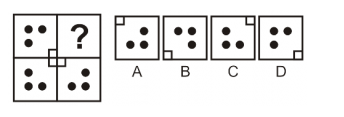
2701 05eec5ed713d72d584fb7cd1c
5eec5ed713d72d584fb7cd1c- 1Afalse
- 2Btrue
- 3Cfalse
- 4Dfalse
- Show AnswerHide Answer
- Workspace
- SingleChoice
Answer : 2. "B"
Q: The folk theater of Karnataka is?
2701 05fc398f34f2f6c622bfa87c0
5fc398f34f2f6c622bfa87c0- 1Yakshaganatrue
- 2Bhavaifalse
- 3Bhagwat Fairfalse
- 4None of thesefalse
- Show AnswerHide Answer
- Workspace
- SingleChoice
Answer : 1. "Yakshagana"
Q: Which type of rock usually underlies a karst landscape? 2701 05b5cc64de4d2b4197774bca7
5b5cc64de4d2b4197774bca7- 1Limestonetrue
- 2Quartzfalse
- 3Granitefalse
- 4All the abovefalse
- Show AnswerHide Answer
- Workspace
- SingleChoice
Answer : 1. "Limestone"
Explanation :
Answer: A) Limestone Explanation: Karst is a type of landscape that is characterized by caverns, caves, sinkholes, and underground streams. These features were all caused by erosion of the underlying rock. Limestone type of rock usually underlies a karst landscape.