


Practice Question and Answer
8 Q:Among Nature’s most intriguing phenomena are the partnerships formed by any different species. The name used for these relationships, Symbiosis, comes from Greek meaning "living together". Not all symbiotic relationships are the same. There are some called commensal relationships, in which one partner gains a benefit while the other gains little or none but is not harmed. One example is the relationship between two types of fish remoras and sharks. The remora, which is long and often striped, attaches itself to a shark (sometimes to another type of fish or a whale), using a sucker on its head. When the shark makes a kill, the hitchhiker briefly detaches itself to feed on the scraps. Another type of symbiotic relationship is parasitism, in which one partner benefits at the expense of others. Ticks and tapeworms are among familiar parasites.
The third type of symbiotic relationship, called mutualism, is a true partnership in which both partners benefit. The relationship may be limited as when zebras and wild best graze together on the vast African grasslands. Each species can survive on its own, but together their chances of detecting predators are improved because each contributes a specially keen sense. (Zebras have the better eyesight; wild beast, hearing and sense of smell). In a few cases partners are so interdependent that one cannot survive without the other. Most mutualistic relationships probably lie some where in between
The passage talks about how animals
1266 063a6bd7a8fc9692134110555
63a6bd7a8fc9692134110555- 1help each other.false
- 2live together.false
- 3take advantage of the weaker ones.false
- 4are related to each other.true
- Show AnswerHide Answer
- Workspace
- SingleChoice
Answer : 4. "are related to each other. "
Q:Among Nature’s most intriguing phenomena are the partnerships formed by any different species. The name used for these relationships, Symbiosis, comes from Greek meaning "living together". Not all symbiotic relationships are the same. There are some called commensal relationships, in which one partner gains a benefit while the other gains little or none but is not harmed. One example is the relationship between two types of fish remoras and sharks. The remora, which is long and often striped, attaches itself to a shark (sometimes to another type of fish or a whale), using a sucker on its head. When the shark makes a kill, the hitchhiker briefly detaches itself to feed on the scraps. Another type of symbiotic relationship is parasitism, in which one partner benefits at the expense of others. Ticks and tapeworms are among familiar parasites.
The third type of symbiotic relationship, called mutualism, is a true partnership in which both partners benefit. The relationship may be limited as when zebras and wild best graze together on the vast African grasslands. Each species can survive on its own, but together their chances of detecting predators are improved because each contributes a specially keen sense. (Zebras have the better eyesight; wild beast, hearing and sense of smell). In a few cases partners are so interdependent that one cannot survive without the other. Most mutualistic relationships probably lie some where in between
Commensal relationship is a type of symbiosis in which the relationship is beneficial
1091 063a6bd14f4e72c5ab6e6c762
63a6bd14f4e72c5ab6e6c762- 1to one and harmless to other.true
- 2to one and harmful to other.false
- 3to both.false
- 4to both for a very short time.false
- Show AnswerHide Answer
- Workspace
- SingleChoice
Answer : 1. "to one and harmless to other."
Q:Among Nature’s most intriguing phenomena are the partnerships formed by any different species. The name used for these relationships, Symbiosis, comes from Greek meaning "living together". Not all symbiotic relationships are the same. There are some called commensal relationships, in which one partner gains a benefit while the other gains little or none but is not harmed. One example is the relationship between two types of fish remoras and sharks. The remora, which is long and often striped, attaches itself to a shark (sometimes to another type of fish or a whale), using a sucker on its head. When the shark makes a kill, the hitchhiker briefly detaches itself to feed on the scraps. Another type of symbiotic relationship is parasitism, in which one partner benefits at the expense of others. Ticks and tapeworms are among familiar parasites.
The third type of symbiotic relationship, called mutualism, is a true partnership in which both partners benefit. The relationship may be limited as when zebras and wild best graze together on the vast African grasslands. Each species can survive on its own, but together their chances of detecting predators are improved because each contributes a specially keen sense. (Zebras have the better eyesight; wild beast, hearing and sense of smell). In a few cases partners are so interdependent that one cannot survive without the other. Most mutualistic relationships probably lie some where in between
Remora attaches itself to the shark or whale
1404 063a6b9ee04f44f63d9a59109
63a6b9ee04f44f63d9a59109- 1by entwining its long body around the bigger fish.false
- 2by biting into the fish’s body with its teeth.false
- 3with an adhesive organ found in its head.true
- 4with a hook like structure in its head.false
- Show AnswerHide Answer
- Workspace
- SingleChoice
Answer : 3. "with an adhesive organ found in its head."
Q:A statement is given followed by four alternative arguments. Select the alternative which is most appropriate.
Statement:
Is it necessary that education should be job oriented?
Arguments:
I. Yes, the aim of education is to prepare persons for earning.
II. Yes, educated person should stand on his own feet after completion of education.
III. No, education should be for sake of knowledge only.
IV. No, one may take up agriculture where education is not necessary.
1296 063a6b36af4e72c5ab6e6754a
63a6b36af4e72c5ab6e6754aIs it necessary that education should be job oriented?
- 1Only I and II arguments are strongtrue
- 2Only III and IV arguments are strongfalse
- 3Only I argument is strongfalse
- 4Only I and III arguments are strongfalse
- Show AnswerHide Answer
- Workspace
- SingleChoice
Answer : 1. "Only I and II arguments are strong "
Q:A statement is given followed by two assumptions, (1) and (2). You have to consider the statement to be true, even if it seems to be at variance from commonly known facts. You are to decide which of the given assumptions can definitely be drawn from the given statement. Indicate your answer.
Statement:
Theoretical education does not bring in economic advancement and it lends to a steady loss of confidence and money in the country.
Assumptions:
(1) There is close relationship between development of confidence and economic development.
(2) Theoretical education makes priceless contribution for development of confidence.
1400 063a6b19e8fc969213410a71b
63a6b19e8fc969213410a71b- 1Only 1 is implicitfalse
- 2Only 2 is implicitfalse
- 3Both 1 and 2 are implicitfalse
- 4Both 1 and 2 are not implicittrue
- Show AnswerHide Answer
- Workspace
- SingleChoice
Answer : 4. "Both 1 and 2 are not implicit "
Q:One statement is given followed by two conclusions I and II. You have to consider the statement to be true even if it seems to be at variance from commonly known facts. You are to decide which of the given conclusions, if any, follow from the given statement. Indicate your answer.
Statement:
No children are voters.
Conclusions:
I. All adults are voters.
II. No voters are children.
1476 063a6b09ebe1dca1b35dc7e8c
63a6b09ebe1dca1b35dc7e8c- 1Only conclusion I followsfalse
- 2Only conclusion II followstrue
- 3Both conclusions I and II followfalse
- 4Neither conclusion I nor II followsfalse
- Show AnswerHide Answer
- Workspace
- SingleChoice
Answer : 2. "Only conclusion II follows "
Q:Directions : The following graph shows production (in thousands) of two types (P and Q) of vehicles by a factory over the years 2009 to 2014. Study the graph and answer the given questions.
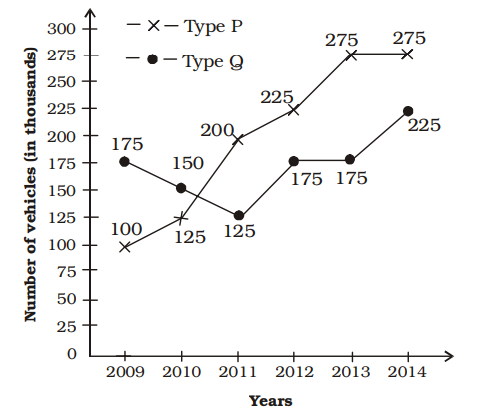
The production of Type Q vehicles in 2010 was approximately what percent of Type P vehicles in 2014?
1021 063a56e408fc9692134069535
63a56e408fc9692134069535 - 160false
- 245.5false
- 354.5true
- 475false
- Show AnswerHide Answer
- Workspace
- SingleChoice
Answer : 3. "54.5 "
Q:Directions : The following graph shows production (in thousands) of two types (P and Q) of vehicles by a factory over the years 2009 to 2014. Study the graph and answer the given questions.
The ratio of total production of Type P vehicles to total production of type Q vehicles over the years is
940 063a56da8b580da5a6237fd52
63a56da8b580da5a6237fd52 - 148 : 41true
- 25 : 8false
- 35 : 8false
- 441 : 48false
- Show AnswerHide Answer
- Workspace
- SingleChoice