


General English Practice Question and Answer
8 Q:Comprehension: In the following passage, some words have been deleted. Read the passage carefully and select the most appropriate option to fill in each blank. Digital India can be the prime (1)________ behind making a reality of the government’s promise of minimum government, maximum governance. Such a transformation requires technology to be firmly (2)_________ into government, something that the Digital India project lists as one of its foremost objectives. Embedding technology into government (3) _________ will do three things; transform the government and make it more transparent and efficient, transform the lives of citizens especially those at the bottom of the (4)_________ pyramid and make our economy more efficient and competitive. A 2014 McKinsey Global Institute report predicts that the large-scale (5) ________ of technology through Digital India positions India with the biggest opportunity yet to accelerate economic growth.
Select the most appropriate option to fill in blank number 2.
1151 06479e66f51bf194753ed1908
6479e66f51bf194753ed1908- 1insertedfalse
- 2embeddedtrue
- 3plantedfalse
- 4stuckfalse
- Show AnswerHide Answer
- Workspace
- SingleChoice
Answer : 2. " embedded"
Q: A sentence has been given with a blank to be filled with an appropriate word. Choose the correct alternative.
Be it a chaat or a refreshing lemonade, lemon is the need of the hour in _______ summers.
1151 06480289c23e51f477704309b
6480289c23e51f477704309bBe it a chaat or a refreshing lemonade, lemon is the need of the hour in _______ summers.
- 1bangingfalse
- 2freezingfalse
- 3scorchingtrue
- 4alleviatingfalse
- Show AnswerHide Answer
- Workspace
- SingleChoice
Answer : 3. "scorching"
Explanation :
The correct word to fill in the blank is "scorching." The sentence is expressing that whether it's chaat or a refreshing lemonade, lemon is essential during extremely hot summers. "Scorching" is used to describe intense heat, making it the appropriate choice in this context.
Q:In the following question, two columns are given containing three phrases each. In the first column, phrases are A, B, and C, and in the second column, the phrases are D, E, and F. A phrase from the first column may or may not connect with a phrase from the second column to make a grammatically and contextually correct sentence. There are five options, four of which display the sequence(s) in which the phrases can be joined to form a grammatically and contextually correct sentence. If none of the options forms a correct sentence after combination, select ‘None of these’ as your answer.
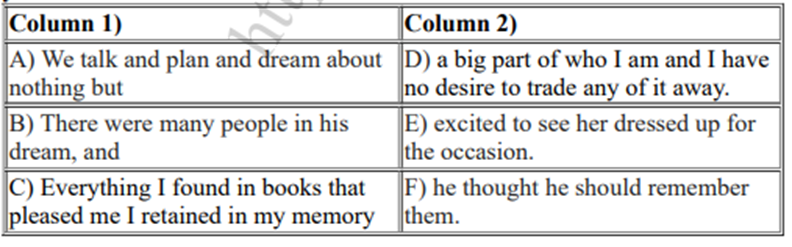
1151 064edf5da2e7e7af712cde0bc
64edf5da2e7e7af712cde0bc
- 1B -E and C-Ftrue
- 2A-E, B-F and C-Dfalse
- 3A-F and C-Dfalse
- 4B-Ffalse
- 5None of thesefalse
- Show AnswerHide Answer
- Workspace
- SingleChoice
Answer : 1. "B -E and C-F"
Q:In the following passage there are blanks, each of which has been numbered. These numbers are printed below the passage and against each, four words are suggested, one of which fits the blank appropriately. Find out the appropriate word in each case.
The preparation (1) vegetarian Rajasthani food (2) the rich and poor of local communities in Rajasthan is almost the same. The difference lies in the (3) of other expensive items like fruit, which the rich bring home (4) returning from the city. Ghee, milk and milk products (5) an important part of rich people’s regular diet, but the poor can only (6) buttermilk. Therefore, it’s important to understand that (7) poverty, access to good (8) is possible if people make the right choices and vice-versa there are low cost but nutritious s available to (9) adequate nutrition. Local cooking and feeding (10) also have an important role to play in the same.
Choose the correct for (3).
1151 0601a03c3552e5f41f7af5b07
601a03c3552e5f41f7af5b07- 1consumptiontrue
- 2gatheringfalse
- 3receivingfalse
- 4growthfalse
- Show AnswerHide Answer
- Workspace
- SingleChoice
Answer : 1. "consumption "
Q:Directions: Read the following passage carefully and answer the questions given below it. Certain words have been printed in bold to help you locate them, while answering some of the questions.
Among those suffering from the global recession are millions of workers who are not even included in the official statistics : urban recyclers – the trash pickers, sorters, traders and reprocesses who extricate paper, cardboard and plastics from garbage heaps and prepare them for reuse. Their work is both unrecorded and largely unrecognized, even though in some parts of the World they handle as much as 20% of all waste.
The World’s 15 million informal recyclers clean up cities, prevent some trash from ending in landfills and thus, reduce climate change by saving energy on waste disposal techniques like incineration. In the developed countries they are the preferred ones since they recycle waste much more cheaply and efficiently than governments or private corporations can. In the developing World, on the other hand, they provide the only recycling services except for a few big cities. But as recession hits the markets Worldwide, the price of scrap metal, paper and plastic has also fallen. Recyclers throughout the World are experiencing a sharp drop in income. Trash pickers and scrap dealers saw a decline of as much as 80% in the price of scrap from October 2007 to October 2009. In some countries scrap dealers have shuttered so quickly that researchers at the Solid Waste Management Association didn’t have a chance to record their losses. In Delhi, some 80% of families in the informal recycling business surveyed by an organization said they had cut back on “luxury foods,” which they defined as fruit, milk and meat. About 41% had stopped buying milk for their children. By this summer, most of those children, already malnourished, hadn’t had a glass of milk in nine months. Many of these children have also cut down on hours spent in school to work alongside their parents. Families have liquidated their most valuable assets – primarily copper from electrical wires – and have stopped sending remittances back to their rural villages. Many have also sold their emergency stores of grain. Their misery is not as familiar as that of the laid-off workers of big name but imploding, service sector corporation, but it is often more tragic. Few countries have adopted emergency measures to help trash pickers. Brazil, for one, is providing recyclers, or “catadores,” with cheaper food, both through arrangements with local farmers and by offering food subsidies. Other countries, with the support of non-governmental organizations and donor agencies are following Brazil’s example. Unfortunately, most trash pickers operate outside official notice and end up falling through the cracks of programmes like these. In the long run, though, these invisible workers will remain especially vulnerable to economic slowdowns unless they are integrated into the formal business sector, where they can have insurance and reliable wages. This is not hard to accomplish. Informal junk shops should have to apply for licences, and governments should create or expand doorstep waste collection programmes to employ trash pickers. Instead of sorting through haphazard trash heaps and landfills, the pickers would have access to the cleaner scrap that comes from households.
The need of the hour, however, is a more immediate solution. An efficient but temporary solution would be for governments where they’d have to pay a small subsidy to waste dealers so they could purchase scrap from trash pickers at about 20% above the current price. This increase, if well advertised and broadky utilized, would bring recyclers a higher price and eventually bring them back from the brink. Trash pickers make our cities healthier and more liveable. We all stand to gain by making sure that the work of recycling remains sustainable for years to come.
Which of the following is true regarding waste recycling in the developing countries?
1151 0618a125c91a73b40d6ee91c6
618a125c91a73b40d6ee91c6Among those suffering from the global recession are millions of workers who are not even included in the official statistics : urban recyclers – the trash pickers, sorters, traders and reprocesses who extricate paper, cardboard and plastics from garbage heaps and prepare them for reuse. Their work is both unrecorded and largely unrecognized, even though in some parts of the World they handle as much as 20% of all waste.
The World’s 15 million informal recyclers clean up cities, prevent some trash from ending in landfills and thus, reduce climate change by saving energy on waste disposal techniques like incineration. In the developed countries they are the preferred ones since they recycle waste much more cheaply and efficiently than governments or private corporations can. In the developing World, on the other hand, they provide the only recycling services except for a few big cities. But as recession hits the markets Worldwide, the price of scrap metal, paper and plastic has also fallen. Recyclers throughout the World are experiencing a sharp drop in income. Trash pickers and scrap dealers saw a decline of as much as 80% in the price of scrap from October 2007 to October 2009. In some countries scrap dealers have shuttered so quickly that researchers at the Solid Waste Management Association didn’t have a chance to record their losses. In Delhi, some 80% of families in the informal recycling business surveyed by an organization said they had cut back on “luxury foods,” which they defined as fruit, milk and meat. About 41% had stopped buying milk for their children. By this summer, most of those children, already malnourished, hadn’t had a glass of milk in nine months. Many of these children have also cut down on hours spent in school to work alongside their parents. Families have liquidated their most valuable assets – primarily copper from electrical wires – and have stopped sending remittances back to their rural villages. Many have also sold their emergency stores of grain. Their misery is not as familiar as that of the laid-off workers of big name but imploding, service sector corporation, but it is often more tragic. Few countries have adopted emergency measures to help trash pickers. Brazil, for one, is providing recyclers, or “catadores,” with cheaper food, both through arrangements with local farmers and by offering food subsidies. Other countries, with the support of non-governmental organizations and donor agencies are following Brazil’s example. Unfortunately, most trash pickers operate outside official notice and end up falling through the cracks of programmes like these. In the long run, though, these invisible workers will remain especially vulnerable to economic slowdowns unless they are integrated into the formal business sector, where they can have insurance and reliable wages. This is not hard to accomplish. Informal junk shops should have to apply for licences, and governments should create or expand doorstep waste collection programmes to employ trash pickers. Instead of sorting through haphazard trash heaps and landfills, the pickers would have access to the cleaner scrap that comes from households.
- 1The government and private organizations services are much costlier than the informal recyclers.false
- 2Barring a few cities, government waste recycling mechanism is completely lacking in these countriesfalse
- 3There has not been any effort in the developing countries to help the struggling recyclersfalse
- 4Global recession has hit the recyclers of the developing countriestrue
- 5None of thesefalse
- Show AnswerHide Answer
- Workspace
- SingleChoice
Answer : 4. "Global recession has hit the recyclers of the developing countries"
Q:Sentences of a paragraph are given below in jumbled order. Arrange the sentences in the correct order to form a meaningful and coherent paragraph.
P. Perhaps no definition of democracy is more popular and universally acceptable than what is given by Abraham Lincoln.
Q. He defines democracy as “a government of the people, by the people and for the people”.
R. Certainly, democracy is the most representative form of government.
S. To bind the people and take the nation ahead on the path of progress, democracy is the most suitable form of government for India.
1151 0649ab29e46047484bc6fc21e
649ab29e46047484bc6fc21eQ. He defines democracy as “a government of the people, by the people and for the people”.
R. Certainly, democracy is the most representative form of government.
S. To bind the people and take the nation ahead on the path of progress, democracy is the most suitable form of government for India.
- 1PSRQfalse
- 2QRSPfalse
- 3PQRStrue
- 4SRQPfalse
- Show AnswerHide Answer
- Workspace
- SingleChoice
Answer : 3. "PQRS"
Q:Direction: In the following questions, a sentence has been given in Active voice. Out of the four alternatives suggested, select the one which best expresses the same sentence in Passive voice.
The flute is being played by Shankar.
1151 0632c6e551656651c9ea45fef
632c6e551656651c9ea45fef- 1Shankar was playing the flutefalse
- 2Shankar is playing the flutetrue
- 3Shankar has been playing the flutefalse
- 4Shankar playing the flutefalse
- Show AnswerHide Answer
- Workspace
- SingleChoice
Answer : 2. "Shankar is playing the flute"
Q:In the following passage, some words have been deleted. Read the passage carefully and select the most appropriate option to fill in each blank.
The effects of plastic bags on the environment are really (1)______ devastating because there is no disposal method that will really help eliminate the problem. The biggest problem with them is that once they have been (2)______, they end up In the trash, which then ends up in the landfill or is burned. The indefinite period of time that it takes for the average plastic bag to break (3)______ can be literally hundreds of years. Throughout the world, plastic bags are responsible for suffocation and deaths of woodland animals as well as (4)______ soil nutrients. The land litter that is made up of plastic bags has the potential to kill over and over again. It has been estimated that one bag has the potential to inadvertently kill one animal per every three months due to unintentional digestion or inhalation. There are always alternatives to plastic bags and the search for more alternatives continues.
Select the most appropriate option to fill in blank number 3.
1150 064a6c82daa4c004ce322d455
64a6c82daa4c004ce322d455- 1throughfalse
- 2outfalse
- 3downtrue
- 4evenfalse
- Show AnswerHide Answer
- Workspace
- SingleChoice