


Non Verbal Reasoning Practice Question and Answer
8 Q: Which option will replace the question mark in the following picture series?

4603 05db292374c6b184b527d31ba
5db292374c6b184b527d31ba- 1false
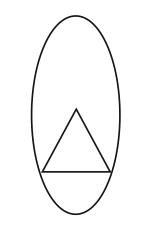
- 2true
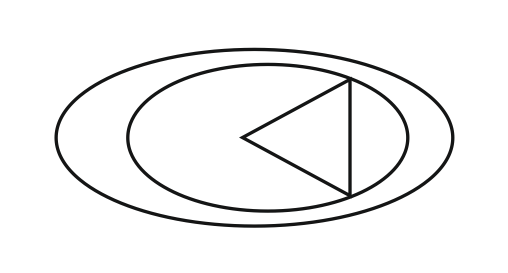
- 3false
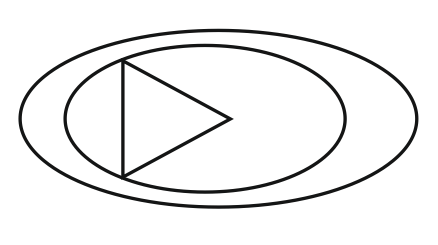
- 4false
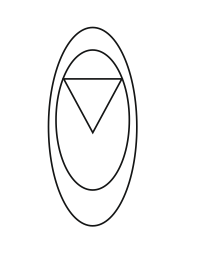
- Show AnswerHide Answer
- Workspace
- SingleChoice
Answer : 2. ""
Q: Find the number of triangles?
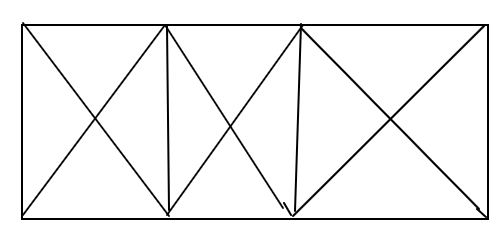
6627 05d2c05cd40a93b3eb992db46
5d2c05cd40a93b3eb992db46- 129false
- 225false
- 328true
- 424false
- Show AnswerHide Answer
- Workspace
- SingleChoice
Answer : 3. "28"
Explanation :
in the above figure it consist 8 triangle so that no. of square is 3 so that total no. of triangle is 8 ✖ 3=24
and 4 triangle shown in question figure so that answer is 24+4=28 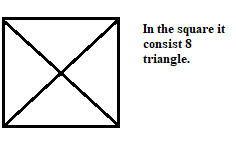
Q: A square paper is folded and cut as shown below. How will it appear when unfolded?
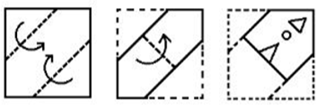
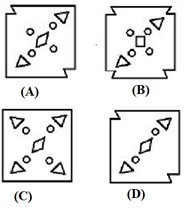
21004 05d43c0e2f54f8b7cc9fe182e
5d43c0e2f54f8b7cc9fe182e- 1Afalse
- 2Bfalse
- 3Cfalse
- 4Dtrue
- Show AnswerHide Answer
- Workspace
- SingleChoice
Answer : 4. "D"
Q: When two dice are thrown simultaneously, what is the probability that the sum of the two numbers that turn up is less than 12? 2911 05b5cc5ffe4d2b4197774b427
5b5cc5ffe4d2b4197774b427- 135/36true
- 217/36false
- 315/36false
- 41/36false
- Show AnswerHide Answer
- Workspace
- SingleChoice
Answer : 1. "35/36"
Explanation :
Answer: A) 35/36 Explanation: When two dice are thrown simultaneously, the probability is n(S) = 6x6 = 36 Required, the sum of the two numbers that turn up is less than 12 That can be done as n(E) = { (1,1), (1,2), (1,3), (1,4), (1,5), (1,6)(2,1), (2,2), (2,3), (2,4), (2,5), (2,6)(3,1), (3,2), (3,3), (3,4), (3,5), (3,6)(4,1), (4,2), (4,3), (4,4), (4,5), (4,6)(5,1), (5,2), (5,3), (5,4), (5,5), (5,6)(6,1), (6,2), (6,3), (6,4), (6,5) } = 35 Hence, required probability = n(E)/n(S) = 35/36.
Q: Two dice are rolled simultaneously. Find the probability of getting a total of 9. 3531 05b5cc7d1e4d2b41977751268
5b5cc7d1e4d2b41977751268- 11/3false
- 21/9true
- 38/9false
- 49/10false
- Show AnswerHide Answer
- Workspace
- SingleChoice
Answer : 2. "1/9"
Explanation :
Answer: B) 1/9 Explanation: S = { (1, 1), (1, 2), (1, 3), (1, 4),(1, 5), (1, 6), (2, 1), (2, 2),.........(6, 5), (6, 6) } => n(S) = 6 x 6 = 36 E = {(6, 3), (5, 4), (4, 5), (3, 6) } => n(E) = 4 Therefore, P(E) = 4/36 = 1/9
Q: Find the number of triangles ?
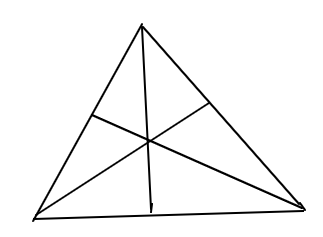
6396 05d2c0a4640a93b3eb992dba5
5d2c0a4640a93b3eb992dba5- 116true
- 213false
- 39false
- 47false
- Show AnswerHide Answer
- Workspace
- SingleChoice
Answer : 1. "16"
Explanation :
3+3+3=9 triangle
Triangle ABD +Triangle ADC =2
Same as 2+2+2=6
And Triangle ABC=1
So that total no of triangle in this figure is 9+6+1=16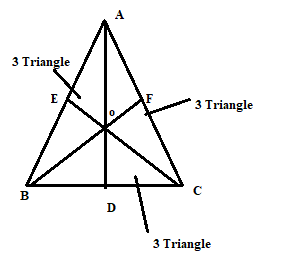
Q: How many triangle is in the given figure?
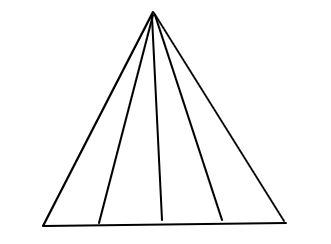
7073 05d2c273440a93b3eb992dc38
5d2c273440a93b3eb992dc38- 110true
- 212false
- 314false
- 416false
- Show AnswerHide Answer
- Workspace
- SingleChoice
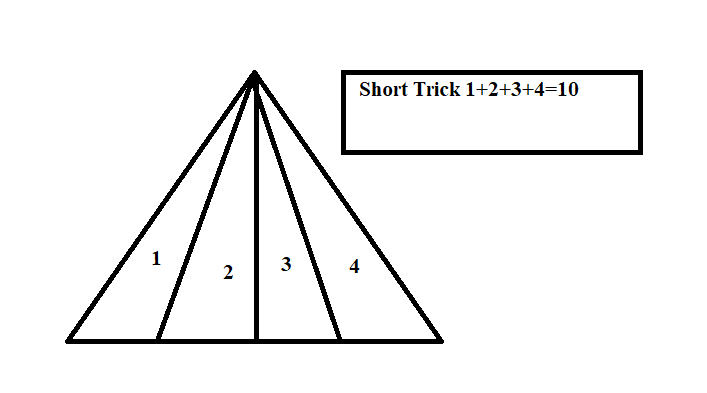
Answer : 1. "10"
Explanation :
Q: Choose a figure which would most closely resemble the unfolded form of Figure (Z).

7705 05d789fa40c830b6303aecf5a
5d789fa40c830b6303aecf5a- 11false
- 22true
- 33false
- 44false
- Show AnswerHide Answer
- Workspace
- SingleChoice