


Verbal Reasoning Practice Question and Answer
8 Q:Directions: Read the given information carefully and answer the following questions:
7 Persons Ram, Mani, Rupa, Mano, Sahil, Saroja, and Ravi are sitting in a linear row facing north. They all like different flowers i.e., Rose, Lily, Jasmine, Marigold, Lotus, Daisy, and Orchid but not necessarily in the same order.
Ravi, who doesn't sit at the extreme ends, sits third to the right of Mani. The number of persons sitting to the right of the one, who likes Orchid is same as the number of persons sitting to the left of Rupa. The one, who likes Lily sits immediate right of Rupa, who sits to the left of Mani. Sahil sits third to the left of Ram, who likes Marigold. Mano sits to the right of Ram. The number of persons sitting to the left of the one, who likes Jasmine is two more than the number of persons sitting to the right of Mano. The one, who likes Rose sits to the left of the one, who likes Daisy. Saroja likes Lotus but does not sit adjacent to Ravi.
Who sits second to the left of the one, who likes Lotus?
1281 064df410f2e3b664a0a4a8d4b
64df410f2e3b664a0a4a8d4b- 1Sahiltrue
- 2Rupafalse
- 3Manifalse
- 4Manofalse
- 5Ravifalse
- Show AnswerHide Answer
- Workspace
- SingleChoice
Answer : 1. "Sahil"
Q: In a certain code language, 'EARLY’ is written as 'ZNSCF' and 'GAUGE' is written as 'FIVCH'. How will 'INBOX' be written in that language?
1281 064806093e72c4684a1e56508
64806093e72c4684a1e56508- 1YQCQJfalse
- 2JPCQYfalse
- 3YQCPJtrue
- 4XPBOIfalse
- Show AnswerHide Answer
- Workspace
- SingleChoice
Answer : 3. "YQCPJ"
Q:Study the following information carefully and answer the questions given below:
Twelve people are sitting in two parallel rows containing six people each, in such a way that there is an equal distance between adjacent persons. In row-1 K, J, I, H, G and V are seated and all of them are facing South. In row-2 Z, Y, X, W, E and U are seated and all of them are facing North. Therefore, in the given seating arrangement each member seated in a row faces another member of the other row.
K sits third to the right of G. Z sits second to the right of E. Neither Z nor E faces G or K. Z does not sits at any of the extreme end. I does not faces Z or E and I does not sits at any of the extreme end. Only one person sits between U and X. Neither U nor X faces G. X does not sits at any of the extreme end. Only one person sit between V and J. U is not an immediate neighbour of Y. Z does not faces V. W sit extreme left end of the row.
Who amongst the following faces Y?
1280 060a25cf9de4c2e1331dbf11f
60a25cf9de4c2e1331dbf11fTwelve people are sitting in two parallel rows containing six people each, in such a way that there is an equal distance between adjacent persons. In row-1 K, J, I, H, G and V are seated and all of them are facing South. In row-2 Z, Y, X, W, E and U are seated and all of them are facing North. Therefore, in the given seating arrangement each member seated in a row faces another member of the other row.
K sits third to the right of G. Z sits second to the right of E. Neither Z nor E faces G or K. Z does not sits at any of the extreme end. I does not faces Z or E and I does not sits at any of the extreme end. Only one person sits between U and X. Neither U nor X faces G. X does not sits at any of the extreme end. Only one person sit between V and J. U is not an immediate neighbour of Y. Z does not faces V. W sit extreme left end of the row.
- 1Ifalse
- 2Gtrue
- 3Vfalse
- 4Hfalse
- 5Jfalse
- Show AnswerHide Answer
- Workspace
- SingleChoice
Answer : 2. "G"
Q:Direction: Read the following information carefully to give the answers to the questions based on it.
Ten people A, B, C, D, E, F, G, H, I and J are sitting around a rectangular table at equidistance (but not necessarily in the same order) in such a way that one of them is sitting at each of the corners, one of them is sitting at each of the shorter sides and two of them are sitting at each of the longer sides. Half of them are facing the centre and half of them are facing away from the centre.
D is not sitting on the shorter side of the table. A sits third to the right of F. I is not an immediate neighbour of B or F but sits on the immediate right of C, who is facing away from the centre and sitting at one of the corners of the table. H is sitting to the immediate left of J. D is sitting third to the left of J. I sits fourth to the left of A. E sits to the immediate left of D and is not an immediate neighbour of C. A and E are facing the same direction. D and G sit diagonally opposite to each other but not necessarily sitting at the corners. D and G are facing opposite directions. H and I are facing the same direction. I do not sit on one of the shorter sides
what is the position of B with respect to I?
1279 06189481f52f0e406ab82e29b
6189481f52f0e406ab82e29bTen people A, B, C, D, E, F, G, H, I and J are sitting around a rectangular table at equidistance (but not necessarily in the same order) in such a way that one of them is sitting at each of the corners, one of them is sitting at each of the shorter sides and two of them are sitting at each of the longer sides. Half of them are facing the centre and half of them are facing away from the centre.
D is not sitting on the shorter side of the table. A sits third to the right of F. I is not an immediate neighbour of B or F but sits on the immediate right of C, who is facing away from the centre and sitting at one of the corners of the table. H is sitting to the immediate left of J. D is sitting third to the left of J. I sits fourth to the left of A. E sits to the immediate left of D and is not an immediate neighbour of C. A and E are facing the same direction. D and G sit diagonally opposite to each other but not necessarily sitting at the corners. D and G are facing opposite directions. H and I are facing the same direction. I do not sit on one of the shorter sides
- 1Immediate leftfalse
- 2Third to the leftfalse
- 3Second to the righttrue
- 4Fourth to the leftfalse
- 5None of thesefalse
- Show AnswerHide Answer
- Workspace
- SingleChoice
Answer : 3. "Second to the right "
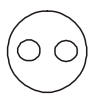
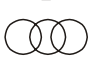
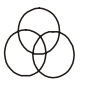
Q:Directions: In each of the following questions, identify the diagram that best represents the relationship among classes given below:
Teacher, Painter, Dramatist
1279 0640b021fa37bb1a5e17080f5
640b021fa37bb1a5e17080f5- 1false
- 2false
- 3false

- 4true
- Show AnswerHide Answer
- Workspace
- SingleChoice
Answer : 4. "
"
Q: Select the odd group of numbers. (NOTE: Operations should be performed on the whole numbers, without breaking down the numbers into its constituent digits. E.g.13 – Operations on 13 such as adding /subtracting /multiplying etc. to 13 can be performed. Breaking down 13 into 1 and 3 and then performing mathematical operations on 1 and 3 is not allowed)
1279 06482d2c0bf323e479a9c86ab
6482d2c0bf323e479a9c86ab- 1(405 –400 –395 )false
- 2(700 –690 –685 )true
- 3(550 –545 –540 )false
- 4(620 – 615 –610 )false
- Show AnswerHide Answer
- Workspace
- SingleChoice
Answer : 2. "(700 –690 –685 )"
Q: Given below is a question followed by two statements I and II. Read both statements carefully to decide which one of them is sufficient to answer the question Six people - K, M, N, P, Q and R are sitting around a circular table facing the centre. Who sits second to the left of P?
(I) K sits to the immediate right of P. Only two people sit between P and Q. R sits second to the right of M.
(II) Only two people sit between N and M. Q is an immediate neighbour of M. Only one person sits between Q and K.
1278 0649967bdab3c5fffc2dc8792
649967bdab3c5fffc2dc8792(I) K sits to the immediate right of P. Only two people sit between P and Q. R sits second to the right of M.
(II) Only two people sit between N and M. Q is an immediate neighbour of M. Only one person sits between Q and K.
- 1Data in statement II alone is sufficient to answer the question while data in statement I is not.false
- 2Data in statement I alone is sufficient to answer the question while data in statement II is not.true
- 3Data in statements I and II together are NOT sufficient to answer the question.false
- 4Data in statements I and II together are sufficient to answer the question.false
- Show AnswerHide Answer
- Workspace
- SingleChoice
Answer : 2. "Data in statement I alone is sufficient to answer the question while data in statement II is not."
Q: Which letter cluster will replace the question mark (?) to complete the given series?
WFBI, UCWB, SZRU, ?
1277 06447a4065bae6d6892495aa9
6447a4065bae6d6892495aa9WFBI, UCWB, SZRU, ?
- 1QWMNfalse
- 2QXNNtrue
- 3QWNNfalse
- 4QXMNfalse
- Show AnswerHide Answer
- Workspace
- SingleChoice