


Data Sufficiency questions Practice Question and Answer
8 Q:Direction: Each of the questions consists of a question and two statements numbered I and II given below it. You have to decide whether the data provide in the statements are sufficient to answer the question. Read both the statements and Give answer.
(A) If the data in statement I alone are sufficient to answer the question, while the data in statement II alone not sufficient to answer the question;
(B) If the data in statement II alone are sufficient to answer the question, while the data in statement I all are not sufficient to answer the question;
(C) If the data either in statement I alone or in statement II alone are sufficient to answer the question;
(D) If the data even in both statements I and II together are not sufficient to answer the question;
(E) If the data in both statements I and II together are necessary to answer the question.
R , K , T and S are four friends . Which of the following is the oldest among them ?
I . The total age of K and T together is more than that of S .
II . The total age of R and K together is less than that of S .
1526 05e8ea0bcf681623fa55c9624
5e8ea0bcf681623fa55c9624(A) If the data in statement I alone are sufficient to answer the question, while the data in statement II alone not sufficient to answer the question;
(B) If the data in statement II alone are sufficient to answer the question, while the data in statement I all are not sufficient to answer the question;
(C) If the data either in statement I alone or in statement II alone are sufficient to answer the question;
(D) If the data even in both statements I and II together are not sufficient to answer the question;
(E) If the data in both statements I and II together are necessary to answer the question.
I . The total age of K and T together is more than that of S .
II . The total age of R and K together is less than that of S .
- 1Afalse
- 2Bfalse
- 3Cfalse
- 4Dtrue
- 5Efalse
- Show AnswerHide Answer
- Workspace
- SingleChoice
Answer : 4. "D"
Q:Directions: The table given below presents the number of books on different subjects kept on separate shelves subjects with odd and even numbers are of arts and Science respectively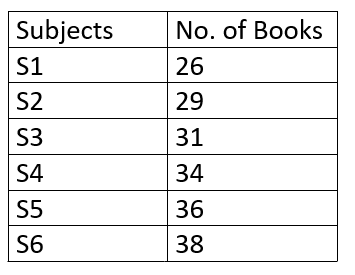
What is the ratio of the total numbers of books on arts to that of science?
1520 05ebb65288dce175b2cb98b51
5ebb65288dce175b2cb98b51- 1145 : 93false
- 2137 : 101true
- 3141 : 97false
- 4149 : 89false
- Show AnswerHide Answer
- Workspace
- SingleChoice
Answer : 2. "137 : 101"
- Show AnswerHide Answer
- Workspace
- SingleChoice
Answer : 3. "C"
Q:Instructions: In each of the questions given below, one question and below it two statements I and II are given. You have to determine whether the data given in the statements is sufficient to answer the question or not.
Answer (A) if the data given in statement, I is sufficient to answer the question whereas data given only in statement II is not sufficient to answer the question.
Answer (B) if the data given only in statement II is sufficient to answer the question whereas data given
only in statement I is not sufficient to answer the question.
Answer (C) if the data given either only in statement I or only in statement II is sufficient to answer the question.
Answer (D) if the combined data given in statement I and statement II are not sufficient to answer the
question.
Answer (E) if the combined data given in statement I and statement II are necessary to answer the question.
Each of A, B, C, D and E are of different heights. Who is the third tallest among these?
I.E is only shorter than B.
II.C is only taller than A.
1493 05fdc7b82d4ac5609e0740757
5fdc7b82d4ac5609e0740757Answer (A) if the data given in statement, I is sufficient to answer the question whereas data given only in statement II is not sufficient to answer the question.
Answer (B) if the data given only in statement II is sufficient to answer the question whereas data given
only in statement I is not sufficient to answer the question.
Answer (C) if the data given either only in statement I or only in statement II is sufficient to answer the question.
Answer (D) if the combined data given in statement I and statement II are not sufficient to answer the
question.
Answer (E) if the combined data given in statement I and statement II are necessary to answer the question.
I.E is only shorter than B.
II.C is only taller than A.
- 1Afalse
- 2Bfalse
- 3Cfalse
- 4Dfalse
- 5Etrue
- Show AnswerHide Answer
- Workspace
- SingleChoice
Answer : 5. "E"
Q:Directions: The following questions are accompanied by three statements (A) or (I), (B) or (II), and (C) or (III). You have to determine which statement(s) is/are sufficient/necessary to answer the questions.
What is the non-voting population of a certain country?
A. Only males above 21 years of age can vote.
B. Males above 21 years form 30% of the total population.
C. The total population of the country is 30 million.
1473 05fd3215ceddcb86a7ee30406
5fd3215ceddcb86a7ee30406A. Only males above 21 years of age can vote.
B. Males above 21 years form 30% of the total population.
C. The total population of the country is 30 million.
- 1A onlyfalse
- 2B onlyfalse
- 3C onlyfalse
- 4A and C onlyfalse
- 5None of the abovetrue
- Show AnswerHide Answer
- Workspace
- SingleChoice
Answer : 5. "None of the above"
Q:Direction: Each of the questions consists of a question and two statements numbered I and II given below it. You have to decide whether the data provide in the statements are sufficient to answer the question. Read both the statements and Give answer.
(A) If the data in statement I alone are sufficient to answer the question, while the data in statement II alone not sufficient to answer the question;
(B) If the data in statement II alone are sufficient to answer the question, while the data in statement I all are not sufficient to answer the question;
(C) If the data either in statement I alone or in statement II alone are sufficient to answer the question;
(D) If the data even in both statements I and II together are not sufficient to answer the question;
(E) If the data in both statements I and II together are necessary to answer the question.
Five years ago, what was the ratio between the age of Sonu and Monu?
I. Ratio between present age of Sonu and Monu is 3: 2.
II. Ratio between present age of Sonu and Ramu is 4 : 3.
1458 05e9e7165ef7e0250489463b9
5e9e7165ef7e0250489463b9(A) If the data in statement I alone are sufficient to answer the question, while the data in statement II alone not sufficient to answer the question;
(B) If the data in statement II alone are sufficient to answer the question, while the data in statement I all are not sufficient to answer the question;
(C) If the data either in statement I alone or in statement II alone are sufficient to answer the question;
(D) If the data even in both statements I and II together are not sufficient to answer the question;
(E) If the data in both statements I and II together are necessary to answer the question.
I. Ratio between present age of Sonu and Monu is 3: 2.
II. Ratio between present age of Sonu and Ramu is 4 : 3.
- 1Afalse
- 2Bfalse
- 3Cfalse
- 4Dtrue
- 5Efalse
- Show AnswerHide Answer
- Workspace
- SingleChoice
Answer : 4. "D"
Q:Directions: Each of the questions consists of a question followed by three statements. You have to study the questions and the statements and decide which of the statements(s) is/are necessary to answer the question.
What is the speed of the train?
I. The train crosses a signal pole in 13 sec.
II. The train crosses a platform of length 250 m in 27 seconds.
III. The train crosses another train running in the same direction in 32 seconds.
1435 05e4e3b721b69e805d0be2c4d
5e4e3b721b69e805d0be2c4dI. The train crosses a signal pole in 13 sec.
II. The train crosses a platform of length 250 m in 27 seconds.
III. The train crosses another train running in the same direction in 32 seconds.
- 1I and II onlytrue
- 2I and III onlyfalse
- 3II and III onlyfalse
- 4Any two of the threefalse
- 5None of thesefalse
- Show AnswerHide Answer
- Workspace
- SingleChoice
Answer : 1. "I and II only"
Q:Direction : Each of the questions below consists of a question and three statements numbered I, II and III given below it. You have to decide whether the data provided in the statements are sufficient to answer the question.
Area of a square is equal to the area of a circle. What is the circumference of the circle?
I. The diagonal of the square is 8 inches.
II. The side of the square is 12 inches.
1429 05ea8fa42a63dac4c26cdeba9
5ea8fa42a63dac4c26cdeba9I. The diagonal of the square is 8 inches.
II. The side of the square is 12 inches.
- 1Data in statement I alone is sufficient to answer the question, while the data in statement II alone is not sufficient to answer the question.false
- 2Data in statement II alone is sufficient to answer the question, while the data in statement I alone is not sufficient to answer the question.false
- 3Data in statement I alone or in statement II alone is sufficient to answer the question.true
- 4Data in both the statements I and II is not sufficient to answer the question.false
- 5Data in both the statements I and II together is necessary to answer the question.false
- Show AnswerHide Answer
- Workspace
- SingleChoice