


Logical Reasoning Questions Practice Question and Answer
8 Q: Statements: All rows are lines
All lines are queues.
Conclusions
I. All rows are queues.
II. Atleast some queues are lines.
3463 05d4c0cac5d0c1b707e924100
5d4c0cac5d0c1b707e924100All lines are queues.
Conclusions
I. All rows are queues.
II. Atleast some queues are lines.
- 1If only conclusion I followsfalse
- 2if only conclusion II followsfalse
- 3if either conclusion I or conclusion II followsfalse
- 4If neither conclusion I nor conclusion II followsfalse
- 5If both conclusions I and II followtrue
- Show AnswerHide Answer
- Workspace
- SingleChoice
Answer : 5. "If both conclusions I and II follow"
Q:Directions: In each of these questions, three words are related in some way. The relationship among the words in the question can best be represented by one of the five diagrams (a), (b), (c), (d) and (e) given below. Mark your answer accordingly.
Mother, Homosapien, Woman
3301 05ec7cbdf2de0eb69a0233b19
5ec7cbdf2de0eb69a0233b19- 1false
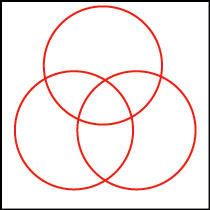
- 2true

- 3false

- 4false

- 5false

- Show AnswerHide Answer
- Workspace
- SingleChoice
Answer : 2. "
"
Q: Direction: In the following questions, the symbol @ , $, *, # and δ are used with the following meaning as illustrated below:
‘P $ Q’ means ‘P’ is not smaller than Q’.
‘P @ Q’ means ‘P is neither smaller than nor equal to Q’.
‘P # Q’ means ‘P is neither greater than nor equal to Q’.
‘P δ Q’ means ‘P is neither greater than nor smaller than Q’.
‘P * Q’ means ‘P is not greater than Q’.
Now in each of the following questions assuming the given statements to be true, find which of the four conclusion I, II , III and IV given below them is/are definitely true and given your answer accordingly.
Statements:
R*D, D $ J, J # M, M@K
Conclusion:
I. K # J
II. D @ M
III. R # M
IV. D @ K
(A) None is true
(B) Only I is true
(C) Only II is true
(D) Only III is true
(E) Only IV is true 3192 05d89e68f6b22180fc608f6f4
5d89e68f6b22180fc608f6f4- 1Atrue
- 2Bfalse
- 3Cfalse
- 4Dfalse
- 5Efalse
- Show AnswerHide Answer
- Workspace
- SingleChoice
Answer : 1. "A"
Q: Statements: Some participants are students.
Some students are boys.
Conclusions I. No boy is a participant.
II. All boys are participants.
3008 05d4c11483a2fce75e19d3593
5d4c11483a2fce75e19d3593Some students are boys.
Conclusions I. No boy is a participant.
II. All boys are participants.
- 1If only conclusion I followsfalse
- 2if only conclusion II followsfalse
- 3if either conclusion I or conclusion II followsfalse
- 4If neither conclusion I nor conclusion II followstrue
- 5If both conclusions I and II followfalse
- Show AnswerHide Answer
- Workspace
- SingleChoice
Answer : 4. "If neither conclusion I nor conclusion II follows"
Q: In this question relationships between different elements are shown in the statements. These statements are followed by two conclusions.
Statements K≤L≤M=N
P≥O≥N
Conclusions. I. K<P
II. K=P
2937 05d4bffc40c5c9f706c696111
5d4bffc40c5c9f706c696111Statements K≤L≤M=N
P≥O≥N
Conclusions. I. K<P
II. K=P
- 1If only conclusion I followsfalse
- 2If only conclusion II followsfalse
- 3If either conclusion I or conclusion II followstrue
- 4If neither conclusion I nor conclusion II followsfalse
- 5If both conclusion I and II followfalse
- Show AnswerHide Answer
- Workspace
- SingleChoice
Answer : 3. "If either conclusion I or conclusion II follows"
Q: Statements A>B>F>C
D>E>C
Conclusions. I. C<A
II. B>D
2878 15d4bfe3b0c5c9f706c695c02
5d4bfe3b0c5c9f706c695c02D>E>C
Conclusions. I. C<A
II. B>D
- 1If only conclusion I followstrue
- 2If only conclusion II followsfalse
- 3If either conclusion I or conclusion II followsfalse
- 4If neither conclusion I nor conclusion II followsfalse
- 5If both conclusion I and II followfalse
- Show AnswerHide Answer
- Workspace
- SingleChoice
Answer : 1. "If only conclusion I follows"
Q: Direction: In the following questions, the symbol @ , $, *, # and δ are used with the following meaning as illustrated below:
‘P $ Q’ means ‘P’ is not smaller than Q’.
‘P @ Q’ means ‘P is neither smaller than nor equal to Q’.
‘P # Q’ means ‘P is neither greater than nor equal to Q’.
‘P δ Q’ means ‘P is neither greater than nor smaller than Q’.
‘P * Q’ means ‘P is not greater than Q’.
Now in each of the following questions assuming the given statements to be true, find which of the four conclusion I, II , III and IV given below them is/are definitely true and given your answer accordingly.
Statements:
N δ B, B$W, W # H, H*M
Conclusion:
I. M @ W
II. H@N
III. WδN
IV. W#N
(A) only I is true
(B) Only III is true
(C) Only IV is true
(D) Only either III or IV is true.
(E) Only Either III or IV and I are 2674 05d89e3fb6b22180fc608f489
5d89e3fb6b22180fc608f489- 1Afalse
- 2Bfalse
- 3Cfalse
- 4Dfalse
- 5Etrue
- Show AnswerHide Answer
- Workspace
- SingleChoice
Answer : 5. "E"
Q:Direction : In each question are given four statements followed by four conclusions numbered I, II, III and IV. You have to assume every thing in the statements to be true even if they seem to be a variance with commonly known facts and then decide which of the four given conclusions logically follows from the statements, disregarding commonly known facts, and select the appropriate answer.
Statements :
All books are files.
Some files are papers.
All papers are certificates.
No certificate is magazine.
Conclusions :
I. At least some books are papers.
II. No magazine is book.
III. At least some certificates are files.
IV. No paper is book.
2663 05ea7ac2b14fb314c31fc94de
5ea7ac2b14fb314c31fc94deAll books are files.
Some files are papers.
All papers are certificates.
No certificate is magazine.
Conclusions :
I. At least some books are papers.
II. No magazine is book.
III. At least some certificates are files.
IV. No paper is book.
- 1Only I, II and IV followfalse
- 2Only II and III followfalse
- 3Only I and IV followfalse
- 4Only III followstrue
- 5None of thesefalse
- Show AnswerHide Answer
- Workspace
- SingleChoice