


Discount Practice Question and Answer
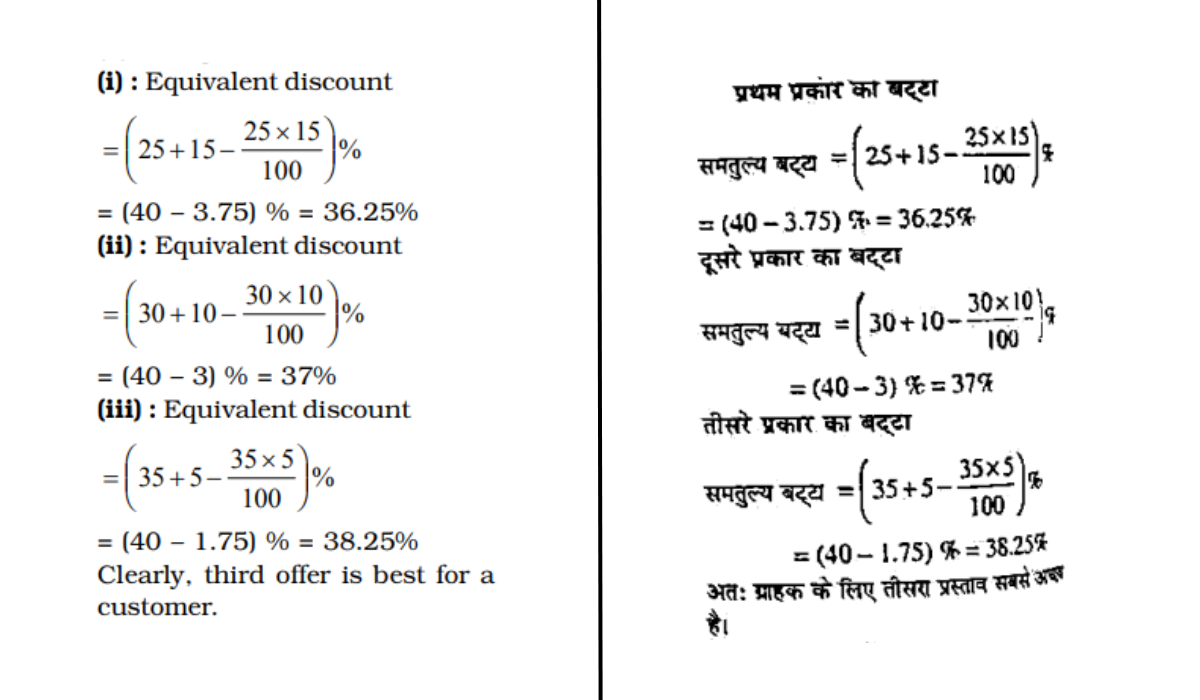
8 Q: A company offers three types of successive discounts: (i) 25% and 15%, (ii) 30% and 10%, (iii) 35% and 5%. Which offer is the best for a customer?
1056 0624d55f067b2505d7e56f709
624d55f067b2505d7e56f709- 1First offerfalse
- 2Second offerfalse
- 3Third offertrue
- 4Any one; all are equally goodfalse
- Show AnswerHide Answer
- Workspace
- SingleChoice
Answer : 3. "Third offer "
Explanation :
Q: A shopkeeper offers the following three schemes. Scheme-I: Two successive discounts of 15% and 25% Scheme-II: Buy 5, get 3 free Scheme-III: Buy 4, get 6 Which scheme is the best for customers?
1033 0647f38e462f8ada0354d5e04
647f38e462f8ada0354d5e04- 1Any one- All are equalfalse
- 2Scheme-Ifalse
- 3Scheme-IItrue
- 4Scheme-IIIfalse
- Show AnswerHide Answer
- Workspace
- SingleChoice
Answer : 3. "Scheme-II "
Q: A shopkeeper marked every item 25%abovethe cost price and allowed 10% discount. Shruti being a regular customer got 5% additional discount on the bill and paid ₹2394 for the item purchased. What is the cost price of the item (in ₹)?
1026 06489bd24b50f5316a45e7170
6489bd24b50f5316a45e7170- 12240true
- 22440false
- 32220false
- 42420false
- Show AnswerHide Answer
- Workspace
- SingleChoice
Answer : 1. "2240 "
Q: Successive discounts of 10% and 10% are equivalent to a single discount of:
1025 0649e816f46047484bc7dbb88
649e816f46047484bc7dbb88- 118%false
- 219%true
- 320%false
- 421%false
- Show AnswerHide Answer
- Workspace
- SingleChoice
Answer : 2. "19%"
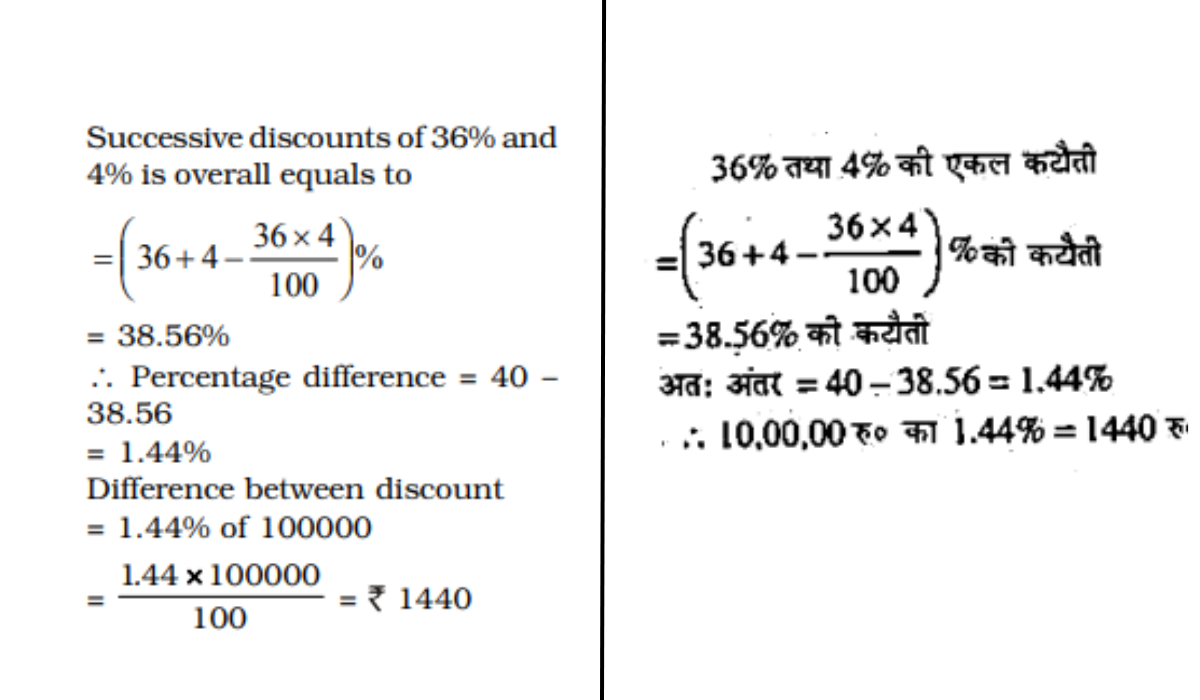
Q: Applied to a bill for ₹ 1,00,000 the difference between a discount of 40% and two successive discounts of 36% and 4% is:
1008 0624d4deebadeb679cf085570
624d4deebadeb679cf085570- 1₹ 2,500false
- 2₹ 4,000false
- 3₹ 1,500false
- 4₹ 1,440true
- Show AnswerHide Answer
- Workspace
- SingleChoice
Answer : 4. "₹ 1,440 "
Explanation :
Q: A trader allows a trade discount of 20% and a cash discount of $$6{1\over4}\%$$ on the marked price of the goods and gets a net gain of 20% of the cost. By how much above the cost should the goods be marked for the sale?
1000 0641027b8df653d9ac23a2502
641027b8df653d9ac23a2502- 140%false
- 250%false
- 360%true
- 470%false
- Show AnswerHide Answer
- Workspace
- SingleChoice
Answer : 3. "60%"
Q: An article is listed at ₹ 7,600 and the discount offered unit is 10%. What additional discount must be given to bring the net selling price to ₹5,814?
982 064ccd955047511ce00801355
64ccd955047511ce00801355- 18%false
- 210%false
- 312%false
- 415%true
- Show AnswerHide Answer
- Workspace
- SingleChoice
Answer : 4. "15%"
Q: If a shopkeeper sells an article at 10% loss by giving half discount on the marked price, then what will be its cost price?
970 0630dedbd7c72c077845c5660
630dedbd7c72c077845c5660- 11/9 of the face valuefalse
- 24/9 of the face valuefalse
- 35/9 of the face valuetrue
- 47/9 of the face valuefalse
- Show AnswerHide Answer
- Workspace
- SingleChoice